B2B buyers are changing how they research vendors, services, technologies, and solutions. Instead of relying only on traditional Google searches, decision-makers can now ask conversational search platforms detailed questions and receive an answer with relevant sources, explanations, comparisons, and recommendations.
A buyer looking for a demand generation partner, for example, might ask which companies serve SaaS businesses in the US, how B2B appointment setting works, or what to consider before outsourcing lead generation to an offshore team.
This shift creates a new opportunity for businesses focused on B2B AI search visibility.
The objective is not simply to rank for another keyword. It is to make your expertise useful enough to be discovered and referenced when potential customers ask questions related to your products, services, industry, or expertise.
For B2B companies targeting the USA and UK, this means creating content around the questions buyers actually ask, providing clear answers, demonstrating expertise, and connecting informational content with meaningful conversion opportunities.
Traditional search behaviour often starts with a short query. A buyer might search for “B2B lead generation agency” and then open several websites to compare services.
Conversational search allows that same buyer to ask a much more detailed question:
“Which B2B lead generation companies can help a SaaS company build qualified pipeline in the US and UK?”
The question contains context, intent, geography, industry, and an expected outcome.
That changes the opportunity for B2B marketers.
Content needs to address complete buyer questions instead of being written exclusively around isolated keywords. A useful page should explain the problem, clarify the available approaches, answer important follow-up questions, and give the reader enough information to determine what they should investigate next.
This is where B2B AI search visibility connects with demand generation. Being discovered during research can introduce your brand before a prospect is ready to complete a contact form or speak with sales.
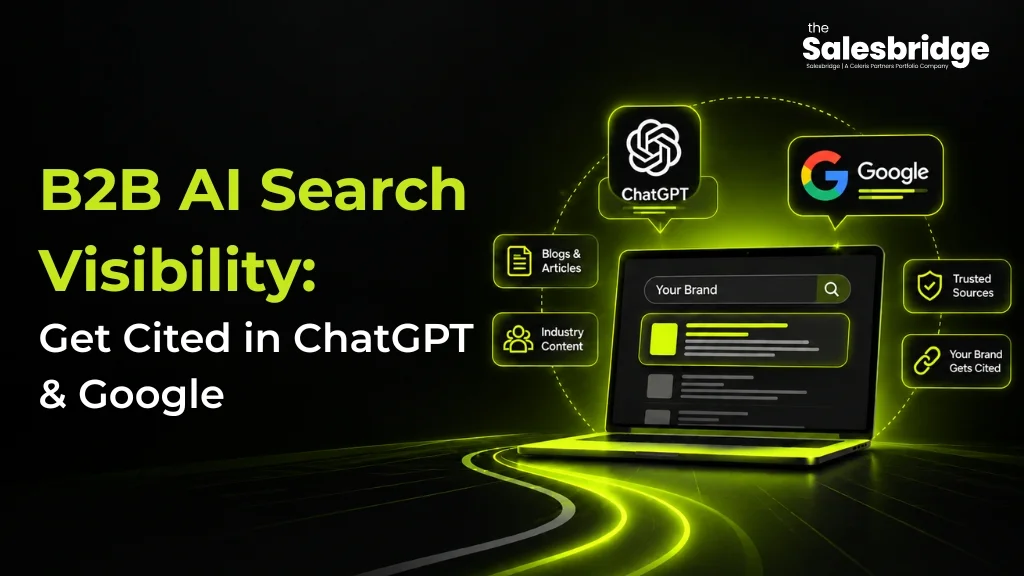
B2B AI search visibility is the ability of a business, its expertise, and its website content to appear or be referenced when potential buyers use conversational search and generative search experiences to research a business problem or purchasing decision.
These experiences include platforms such as ChatGPT, Perplexity, and Google’s AI-powered search features.
The traditional SEO question is:
“Can my website rank for this search?”
The emerging question is:
“Can my content become a useful source for the answer a buyer receives?”
These are related but different objectives.
Strong technical SEO, crawlable pages, relevant content, internal linking, clear page structure, and genuine topical expertise continue to provide the foundation. Google states that there are no additional technical requirements specifically for appearing in AI Overviews or AI Mode, meaning businesses should continue applying established SEO fundamentals while creating useful content for people.
Answer Engine Optimization B2B should not be treated as a replacement for SEO.
Instead, think of it as an extension of a broader search strategy.
Traditional SEO helps search engines understand and retrieve your pages. Answer-focused content makes those pages more useful for questions that require explanation, comparison, context, or multiple pieces of information.
Consider a B2B buyer researching appointment setting.
A conventional SEO page might target “B2B appointment setting services.”
An answer-focused content strategy could additionally address:
What is B2B appointment setting?
How does appointment setting work?
What makes an appointment sales-qualified?
When should a company use an outsourced appointment-setting team?
How should an organisation measure appointment-setting performance?
These questions create a connected content journey rather than a single keyword-targeted page.
AI-powered search experiences can interpret questions in a more conversational way than traditional keyword matching.
That makes context particularly important.
A page discussing “lead generation” without explaining the audience, process, qualification criteria, geography, industry, or business outcome provides limited context.
A detailed page explaining how a B2B demand generation campaign identifies target accounts, develops buyer-specific messaging, captures intent, qualifies prospects, and moves them toward sales provides much more useful information.
This is why get cited in ChatGPT for B2B should not be approached as a technical trick.
There is no reliable formula that guarantees a citation.
Instead, the focus should be on creating pages that clearly answer relevant buyer questions and provide information worth referencing.
Start with your buyers, not your keyword tool.
Identify the questions that prospects ask before they understand your service, while comparing possible solutions, and immediately before contacting a provider.
For a B2B demand generation company, those questions could range from “What is demand generation?” to “How can a SaaS company generate qualified enterprise leads in the US?”
The important step is understanding the progression.
A buyer who starts with an educational question may later ask about pricing, providers, implementation, timelines, or expected outcomes.
Your content architecture should reflect that journey.
Once the questions are identified, structure pages so that important answers are easy to understand.
Avoid beginning every section with several paragraphs of promotional copy.
If the heading asks “What is B2B demand generation?”, answer the question immediately. Then provide context, examples, methodology, and relevant considerations.
This creates a better experience for readers and gives search systems clearly structured information to interpret.
The same principle applies to longer-form articles. Descriptive H2 and H3 headings should communicate exactly what the following section explains.
Generic content is unlikely to differentiate a B2B brand.
If ten websites make the same statement about demand generation, publishing an eleventh version does little to establish a distinctive source.
Instead, demonstrate expertise through original frameworks, practical processes, market observations, campaign methodologies, examples, research, and clearly explained recommendations.
For example, a B2B company could explain exactly how it moves from ideal customer profile development to account research, campaign execution, qualification, sales handoff, and pipeline measurement.
This gives the content a perspective that goes beyond repeating definitions found elsewhere.
AI search visibility does not mean every article should exist independently.
Build relationships between your content.
For example, a reader researching AI search visibility may also need information about demand generation, lead management, content syndication, and international campaign execution.
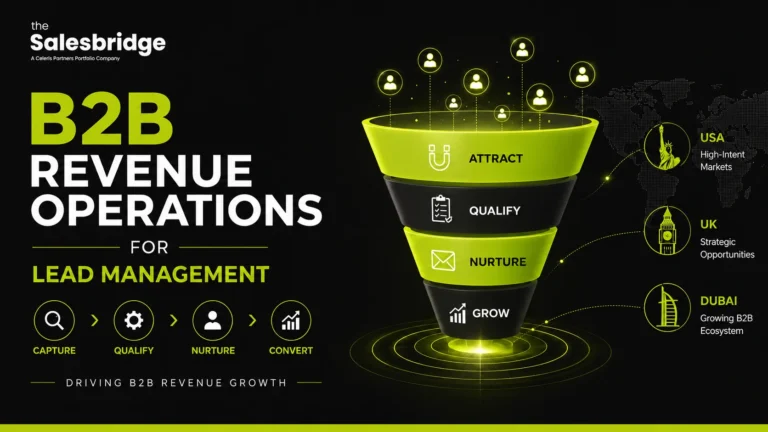
The Salesbridge already has relevant resources that can support this topic cluster. Its article on B2B Revenue Operations for Lead Management explains how demand generation, lead capture, qualification, routing, follow-up, and revenue operations connect across the buyer journey.
That is a natural internal connection because AI-search visibility only becomes commercially valuable when the resulting interest can move into an organised lead-management and revenue process.
Structured data can help search engines understand the content and purpose of a page when the markup accurately represents visible content.
However, schema should not be positioned as a shortcut for getting cited.
Google’s documentation states that there is no special structured-data requirement specifically for AI Overviews or AI Mode. Businesses should therefore use relevant supported structured data correctly while continuing to focus on crawlability, content quality, page structure, and user experience.
For a blog such as this one, appropriate Article and Breadcrumb structured data may be relevant depending on the website implementation.
Search visibility should ultimately support a business objective.
A buyer might discover an educational article, read another resource, investigate a service, and eventually submit an enquiry.
That journey should feel natural.
For example:
AI search visibility → B2B demand generation content → service evaluation → consultation
The CTA should therefore relate directly to the problem discussed on the page.
There is no guaranteed method to make a page appear in every ChatGPT answer.
However, B2B marketers can improve the usefulness and discoverability of their content by answering specific questions clearly and publishing information that provides genuine value.
Start with topics where your company has real expertise.
Instead of publishing an article simply targeting “B2B lead generation,” create a resource that explains how B2B lead generation works for a specific audience, market, industry, or business challenge.
Use descriptive headings and answer important questions directly.
Then support those answers with examples, processes, definitions, original insights, and links to related resources.
The objective is to create a page that a buyer would genuinely find useful even without considering how an AI search platform might retrieve it.
Google AI Overviews lead generation is best understood as part of the wider search journey rather than as a separate advertising channel.
A potential buyer may encounter an AI-generated search response while researching a complicated business problem. Supporting links can then introduce the buyer to websites they might not have discovered through a conventional search journey.
This makes comprehensive B2B content increasingly valuable.
A company selling enterprise technology, for example, can create content addressing implementation considerations, vendor evaluation, common challenges, pricing factors, integration questions, and operational requirements.
Those resources can attract prospects at different stages of the buying process.
Google also recommends continuing to create unique, useful content rather than producing large volumes of pages designed primarily to manipulate generative search results.
Perplexity AI B2B citations represent another opportunity for brands to become part of a buyer’s research process.
The strongest approach is to create source-worthy content.
Think about the information a buyer would need if they were researching your category for the first time.
If you sell demand generation services, useful resources could explain how demand generation differs from lead generation, how qualification works, how campaigns should be measured, and what businesses should evaluate before selecting a partner.
Comparison and decision-support content can also be valuable when written objectively and with meaningful detail.
The key is to answer the actual question rather than creating a page primarily designed to promote your company.
AI search visibility should eventually be measured against business outcomes.
Start by creating a defined set of buyer prompts covering your priority services, industries, locations, and problems.
For example, a B2B marketing company targeting the US and UK could monitor questions around demand generation agencies, outsourced demand generation, B2B lead generation, appointment setting, content syndication, and revenue operations.
Review which brands and websites appear in the responses and which sources are referenced.
Then compare that visibility with your wider search performance.
Organic impressions, branded searches, website engagement, enquiries, consultation requests, qualified leads, and opportunities provide more meaningful business context than citation counts alone.
The important question is not simply whether your company appeared in an answer.
It is whether search visibility contributed to a buyer discovering, researching, and engaging with your business.
At The Salesbridge, answer-focused content can work as part of a broader B2B demand generation system.
The process begins by understanding the questions and challenges of the target audience. Those questions can then be mapped to content, search intent, buyer stages, and conversion paths.
For companies targeting the USA and UK, this can be particularly useful when content needs to reflect different markets, industries, buyer roles, and commercial requirements.
The Salesbridge’s Offshore Demand Generation for US & UK B2B Companies explains how a blended delivery model can combine market-facing account management with offshore research, campaign operations, data enrichment, qualification, and execution.
That topic naturally connects with AI search visibility because the same buyer-focused approach applies: understand the market, identify the right audience, create relevant messaging, and connect activity to measurable pipeline outcomes.
Content distribution is another part of the wider system.
The Salesbridge’s resource on B2B Content Syndication for Qualified Decision-Makers provides a relevant supporting topic for businesses looking beyond organic search to reach specific B2B audiences.
Together, these approaches create a broader demand generation ecosystem in which search visibility is one source of discovery rather than the entire strategy.
A practical content strategy should begin with commercial questions.
What problems does the target buyer research?
Which questions appear before the buyer understands the solution?
What information do they need when comparing providers?
Which objections prevent them from making contact?
What evidence would help them evaluate a solution?
Once these questions are mapped, create content that answers them in a logical sequence.
An awareness article can introduce the problem.
A detailed guide can explain the solution.
A comparison page can help with evaluation.
A case study can demonstrate practical application.
A service page can explain how your company helps.
A contact page can provide the next step.
This creates a connected journey from discovery to demand capture.
B2B AI search visibility is the ability of a B2B company and its content to be discovered, referenced, or linked when potential buyers use conversational search platforms to research business problems, services, products, or vendors.
Create useful, clearly structured content that directly answers questions relevant to your target buyers. Focus on original expertise, specific information, strong topical coverage, crawlable pages, and accurate internal linking rather than trying to manipulate citations.
No. Answer Engine Optimization B2B works alongside SEO. Strong technical foundations, crawlability, useful content, internal links, and appropriate structured data remain important for search visibility, including Google’s AI search experiences.
Google AI Overviews can introduce users to supporting web content during complex searches. For B2B companies, the opportunity is to create useful resources that answer questions across the buying journey and connect those resources to relevant commercial pages and enquiry paths.
Create a consistent set of buyer prompts, monitor whether your brand and website are referenced, identify the pages being cited, and compare that visibility with organic traffic, branded searches, engagement, enquiries, qualified leads, and pipeline contribution.
Being discovered in an AI-powered search result is only the beginning.
The commercial opportunity comes from what happens after discovery.
When your content answers a buyer’s question clearly, demonstrates expertise, connects to related resources, and provides a relevant next step, search visibility can become part of a measurable demand generation journey.
If your company is looking to increase visibility among B2B decision-makers in the USA or UK, The Salesbridge can help connect B2B demand generation, content strategy, lead generation, qualification, and pipeline development into one coordinated approach.
Ready to turn buyer searches into qualified B2B opportunities?
Talk to The Salesbridge about building a demand generation strategy aligned with your target market and growth objectives.