
Most B2B teams do not have a content problem. They have an account access problem.
You may have a strong whitepaper, a useful research report, or a practical case study. You may distribute it through content syndication and receive a steady flow of contacts. Yet the sales team still asks the same questions: Who are these people? Do they influence a purchase? Is the company actually in the market? Why are so few conversations turning into meetings?
The answer is often hidden in the difference between collecting a contact and reaching a buying group. B2B content syndication works best when it is designed to create access to the right accounts and the right decision-makers, not simply to maximise form fills. A contact who downloads an asset is a useful signal. A verified person from a target account who is researching a relevant business problem is a much stronger commercial opportunity.
For US and global B2B companies selling SaaS, IT services, cybersecurity, fintech, cloud, or enterprise solutions, this distinction matters. Sales cycles involve multiple stakeholders, so campaigns must be built around account relevance, buying intent, and follow-up.
Content syndication means distributing your educational content through third-party channels to reach audiences beyond your owned website. Done properly, it can extend the life of an asset, introduce your brand to new prospects, and create a measurable source of demand. It is not automatically a shortcut to sales.
The gap appears when a campaign reports success using only the number of leads delivered. A database can grow while sales productivity falls. The programme may be reaching students, junior researchers, unqualified businesses, competitors, or people outside your serviceable market. Even when a contact is genuine, that person may not be connected to the purchasing committee.
A stronger programme measures account access alongside contact volume. It asks whether the campaign reached companies that match the ideal customer profile, whether contacts hold relevant roles, whether several people from one account are engaging, and whether their behaviour suggests active research. This changes the goal from “more names” to “more relevant buying conversations.”
A lead is an event. Pipeline is a process.
The event may be a download, registration, click, or content view. The process includes validation, enrichment, scoring, nurturing, outreach, discovery, opportunity creation, and revenue. If the hand-off is weak, more contacts only increase the workload for marketing and sales.
The pattern usually comes from broad audience definitions, content that is disconnected from the commercial problem, or a campaign that stops when the lead is delivered. Without coordinated follow-up, useful engagement data is lost.
Judge a syndication partner on transparency and downstream quality. Ask where the content appears, how the audience is selected, how consent is captured, how contacts are verified, and what happens when a record fails your criteria.
Before choosing a channel, define the accounts you want by industry, employee range, technology stack, region, business model, and relevant trigger. Then map the buying group instead of naming one job title. A technology purchase can involve a sponsor, evaluator, finance, procurement, and senior approver.
This is especially important for global buying groups, where headquarters, regional offices, parent companies, and implementation partners may influence a purchase. Distinguish between a contact who evaluates the solution and one who can approve budget or introduce the vendor internally.
A strong content asset should help the reader recognise a problem and understand the next step. Educational content usually works better at the first touch than a product brochure. A checklist, benchmark report, implementation guide, or sector-specific case study can create a stronger signal than a generic download.
The landing-page form should support qualification without becoming unnecessarily difficult. Ask only for information the sales team will use, such as company, role, business email, country, and relevant challenge, while explaining what the reader will receive and how the information will be used.
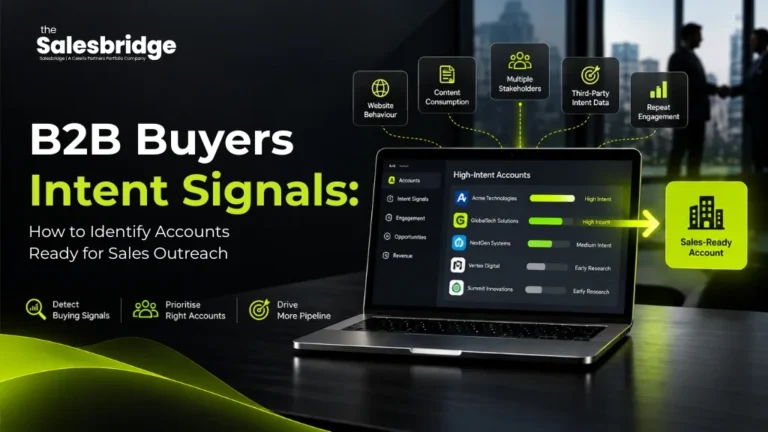
Firmographic fit tells you whether an account could buy. Intent signals help indicate whether it may be researching the problem now. Useful signals can include repeated engagement with a topic, multiple visits from the same company, interaction with related assets, webinar attendance, or interest from several roles within one account.
Intent is not proof of a buying decision. It is a reason to prioritise, personalise, and investigate. Use it to guide the next action: nurture an early researcher, send a relevant case study, invite a stakeholder to a consultation, or coordinate outreach across the buying group.
A practical B2B content syndication programme connects marketing, sales, and revenue operations. Marketing owns audience, message, content, and learning. Sales defines a useful opportunity and responds while interest is fresh. Revenue operations ensures clean CRM flow, visible scoring, and consistent measurement.
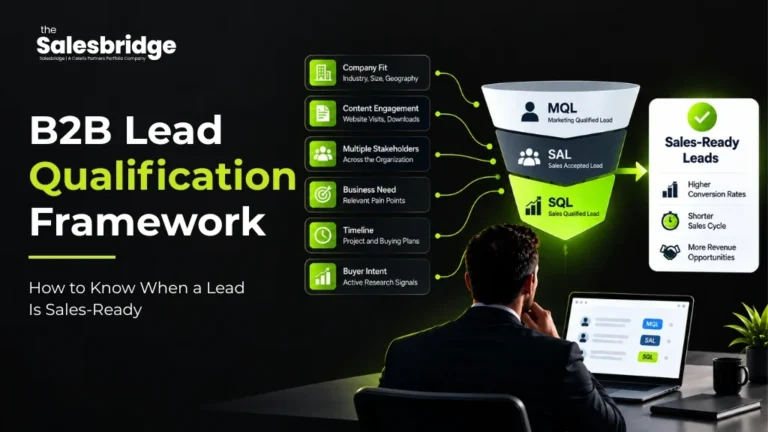
Use a simple sequence: deliver the asset and capture consent; validate the contact and enrich the account; score fit and engagement separately; route high-priority accounts to sales; nurture earlier-stage contacts; and review meetings, opportunities, and revenue not only delivery volume.
| Measure | What it tells you |
|---|---|
| Target-account reach | Whether distribution is reaching the companies you can serve |
| Buying-role coverage | Whether more than one relevant stakeholder is entering the account |
| Content engagement | Whether the asset is attracting meaningful attention |
| Accepted lead rate | Whether sales agrees that the contacts meet the brief |
| Meeting rate | Whether the follow-up creates conversations |
| Opportunity and pipeline value | Whether the campaign contributes to commercial growth |
This model creates a feedback loop. Sales objections improve the content. Engagement patterns improve targeting. Account activity improves prioritisation. The programme becomes more accurate with each campaign instead of repeating the same broad distribution.
Do not compare providers only on cost per lead. Compare the quality of access they can create. Request a clear explanation of their inventory, audience sources, targeting logic, consent process, verification method, delivery fields, replacement policy, and reporting cadence. If a provider cannot explain how a contact discovered your content, treat that as a warning sign.
Confirm that the campaign supports your target markets, industries, company sizes, and job functions. Ask how it handles duplicates, personal email addresses, incomplete records, and contacts outside your criteria. Review consent, privacy, and data-handling requirements across the markets you serve before launch.
Finally, confirm what happens after delivery. A partner that supplies data but leaves your team to design nurture, routing, and sales follow-up may not solve the account access gap. The strongest approach connects distribution with demand generation, personalised outreach, appointment setting, and usable reporting.
The Sales Bridge helps B2B companies build predictable pipeline through AI-powered prospecting, personalised outreach, intent-driven campaigns, and full-funnel demand generation. That makes the account access problem a useful starting point for a wider growth conversation.
If your current programme produces contacts but not enough qualified meetings, explore the Demand Generation solutions and review how a connected process can support targeting, outreach, and pipeline progression. Teams that need stronger data, CRM alignment, and measurement can also explore Revenue Operations insights. For broader campaign and positioning support, see the Digital Marketing resources.
Add contextual internal links to the B2B blog and insights hub, relevant case studies, and whitepapers or ebooks. Each link should support the next logical step.
B2B content syndication is the distribution of business content through relevant third-party channels to reach new professional audiences. When connected to a defined ICP, consent-based data, and follow-up, it can support qualified lead generation and account engagement.
It generates stronger leads when the campaign targets the right accounts, promotes useful content, verifies contact information, captures relevant buying roles, and uses engagement signals to prioritise follow-up. A download alone does not make a lead sales-qualified.
Content syndication expands content reach and identifies engaged contacts. Account-based marketing focuses on selected accounts with coordinated, personalised engagement. Used together, syndication can surface signals and additional stakeholders while ABM deepens account-level conversations.
Yes, provided the programme supports the industries, regions, company profiles, and buying roles that matter to the business. US and global campaigns should review consent, privacy, data quality, and follow-up across distributed buying committees.
Track target-account reach, buying-role coverage, validated contacts, accepted leads, meeting rate, opportunity creation, pipeline value, and revenue influence. Cost per lead is useful for budgeting, but it should not be the only measure of performance.
If your syndication dashboard looks healthy but your sales pipeline does not, the next step is to examine account fit, buying-role coverage, intent signals, routing, and follow-up. Book a strategy conversation with The Sales Bridge through the Contact Us page to identify the gaps in your current demand-generation process and build a clearer path from content engagement to qualified meetings.