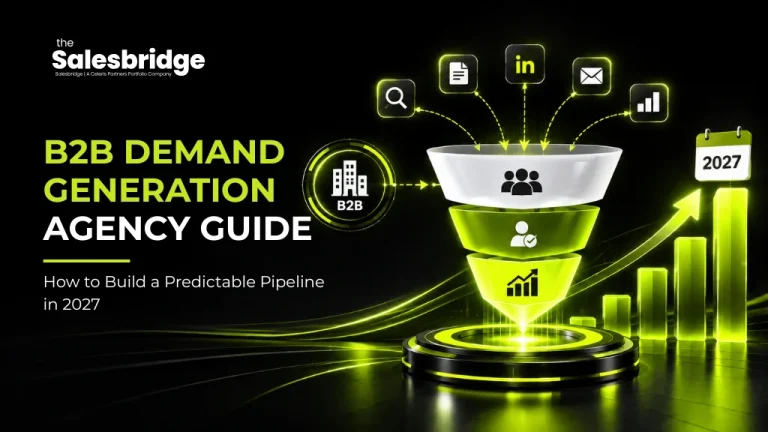
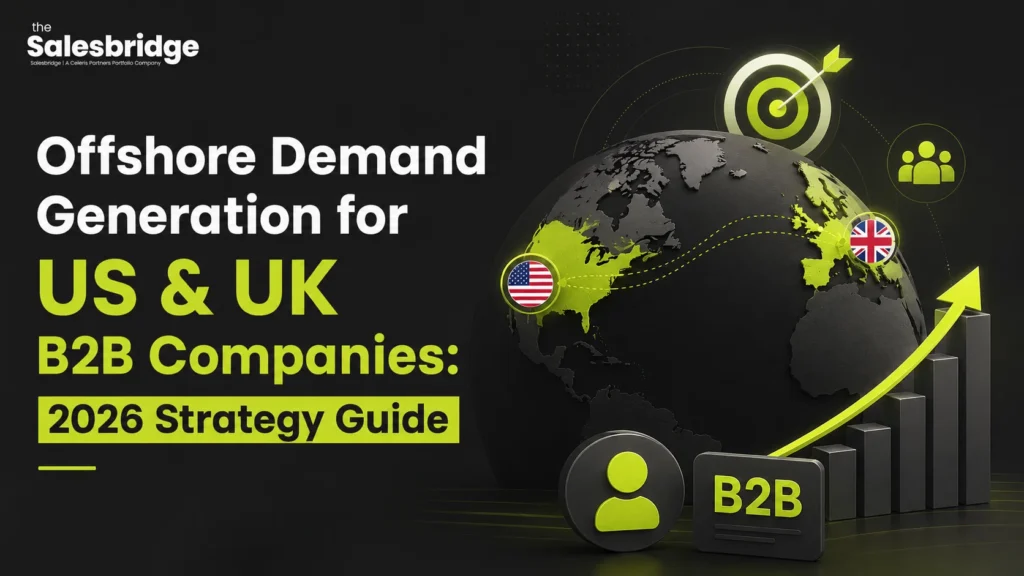
Modern offshore demand generation is the coordinated use of research, data, content, outbound engagement, qualification, and revenue operations from a delivery team outside the target market. It is broader than buying a list or asking low-cost callers to book as many meetings as possible. A credible program connects target-account strategy to measurable pipeline outcomes: engaged accounts, marketing-qualified leads (MQLs), high-quality leads (HQLs), sales-qualified leads (SQLs), accepted meetings, opportunities, and revenue.
The word offshore describes where execution capacity sits, not where strategy, accountability, or buyer understanding should sit. For US and UK campaigns, the strongest operating model usually combines local or market-fluent account management with offshore research, campaign operations, data hygiene, personalization, and first-touch execution. The result is a blended pod that can extend coverage without requiring the client to recruit, manage, and equip a complete in-house team.
Legacy cold calling measures effort: dials, emails sent, and contacts reached. Modern ABM measures progression through a defined buying journey. Marketing and sales first agree on the accounts that matter, the business problems that create urgency, the people who influence a purchase, and the evidence that an account is moving from awareness to active evaluation.
That changes the campaign brief. Instead of giving an SDR an undifferentiated spreadsheet, the pod receives an ideal customer profile (ICP), named accounts, buying triggers, relevant proof points, contact roles, exclusion rules, and a qualification rubric. Outreach can then combine email, phone, LinkedIn, content syndication, webinars, and retargeting where appropriate. The objective is not to make every contact respond; it is to create useful, consent-aware interactions with accounts that have a plausible path to revenue.
A blended model keeps strategic decisions close to the client and the buyer. A US- or UK-facing account lead owns positioning, weekly pipeline reviews, escalation, and executive communication. Offshore specialists provide research, list building, enrichment, campaign execution, meeting coordination, reporting, and operational coverage across time zones.
This arrangement only works when ownership is explicit. The statement of work should define who controls the data, who approves messaging, who handles objections, who accepts or rejects a meeting, how opt-outs are synchronized, and what happens when a contact requests privacy information. The client remains responsible for the business purpose and should not assume that outsourcing transfers regulatory responsibility.
The following table is a planning model, not a quote. It assumes one focused campaign pod, standard B2B technology, and a defined ICP. Actual costs vary by market, ACV, data requirements, language coverage, channel mix, and meeting acceptance criteria.
| Cost and operating factor | In-house US/UK SDR team | Offshore demand-generation pod | Practical implication |
| Core people cost | US: roughly $60k base / $85k OTE per SDR; UK: roughly £39.5k base / £59.4k OTE per SDR | Often modeled at $4k–$15k per month for a managed pod | Compare outcomes and management load, not just headline pay |
| Fully loaded annual cost | Commonly 110k–160k+ per US SDR after benefits, tools, recruiting, management, and ramp; UK equivalent depends on employer costs and tooling | Approximately $48k–$180k per year at the modeled range | A pod can be cheaper at small scale, but quality and scope must be equivalent |
| Tech stack | CRM, sequencing, dialer, data, enrichment, call recording, analytics, inboxes | Usually included or partly included; confirm ownership, licenses, and export rights | Hidden license exclusions can erase apparent savings |
| Ramp time | Often 2–4 months before consistent productivity, depending on complexity | Faster launch if the provider already has trained operators and playbooks | Faster does not mean instant; ICP and messaging still require validation |
| Coverage | Limited by working hours and headcount | Can provide extended time-zone coverage and specialist roles | Define handoff windows and escalation coverage |
| Typical output unit | Activity, accepted meetings, SQLs, or opportunities | Retainer, qualified lead, accepted meeting, or hybrid | Pay for a definition your sales team accepts |
| Directional cost per lead | Highly variable; low CPL may conceal weak fit | Vendor-market references commonly show about $84–$400+ per lead, while monthly retainers may range from 2.5k–15k+ | Use cost per accepted opportunity or pipeline dollar as the senior metric |
| Control and learning | Highest direct control; learning stays inside the company | Requires governance, shared CRM, QA, and documented feedback loops | Contract for transparency, not just volume |
A sensible 2026 budget conversation starts with the revenue model. If the campaign needs 12 accepted meetings per month and the pod costs $9,000, the modeled cost per accepted meeting is $750. That figure is meaningful only if “accepted” means the account fits the ICP, the contact has the required role, the problem is relevant, and the sales team confirms the meeting. A meeting that is rejected for poor fit is not a successful unit of output.
Offshore delivery does not create a compliance loophole. It creates a need for clearer data-processing roles, access controls, approved scripts, suppression processes, and audit trails. The legal analysis depends on the recipient, channel, message, personal-data use, and jurisdictions involved. This section is operational guidance, not legal advice; have qualified US and UK counsel review the actual campaign, contracts, data sources, and transfer arrangements before launch.
The UK ICO distinguishes corporate subscribers from sole traders and some partnerships. Companies and LLPs generally fall into the corporate-subscriber category, while sole traders and certain partnerships receive stronger protections under PECR. The distinction matters because PECR’s electronic-mail rule does not apply in the same way to corporate subscribers, but UK GDPR still applies when the campaign processes personal data, such as a named employee’s work email address.
For live marketing calls, the ICO says teams should screen against both the Corporate Telephone Preference Service (CTPS) and the Telephone Preference Service (TPS), as well as their own suppression list. A compliant calling process should also identify the caller, display a valid number, respect previous objections, record the source and screening date, and route opt-outs into a shared do-not-contact system.
For email and other electronic messages, do not treat a public business address as a universal permission slip. Document the purpose, source, relevance, lawful basis where personal data is used, privacy information, objection process, and retention period. If relying on legitimate interests, complete and retain a legitimate-interests assessment; do not use the label as a substitute for balancing necessity, reasonable expectations, and the person’s rights.
Compliance and deliverability are different controls, but they reinforce each other. The sender must tell the truth about identity and purpose, while the mailbox provider evaluates authentication, reputation, complaint rates, engagement, and sending behavior.
Google’s sender guidance requires all senders to personal Gmail accounts to use SPF or DKIM and recommends SPF, DKIM, and DMARC; bulk senders are expected to implement all three. Google also highlights TLS, valid reverse DNS, gradual volume increases, reputation monitoring, and easy unsubscribe mechanisms. Marketing messages above 5,000 per day to personal Gmail accounts must support one-click unsubscribe.
A responsible warm-up protocol uses a dedicated, correctly authenticated sending domain or subdomain, starts with modest volumes, verifies addresses before sending, suppresses hard bounces and complaints quickly, avoids deceptive display names and fake reply threads, and increases volume only when reputation and engagement remain healthy. No warm-up tool can make an irrelevant list safe. List quality, targeting, message relevance, and fast suppression are the real safeguards.
US campaigns must also account for CAN-SPAM. The FTC states that CAN-SPAM applies to commercial email, including B2B email, and requires truthful headers, non-deceptive subject lines, a clear commercial identification where applicable, a valid physical postal address, a clear opt-out mechanism, and prompt processing of opt-outs. The FTC further states that hiring another company does not remove the advertiser’s responsibility; both the promoted company and sender may face responsibility.
The Salesbridge publicly describes its model as AI-powered B2B demand generation spanning prospecting, personalized outreach, intent-driven campaigns, qualified meetings, appointment setting, SDR-as-a-service, webinar registration, and data building. A practical framework for delivering that promise is the following five-stage system.
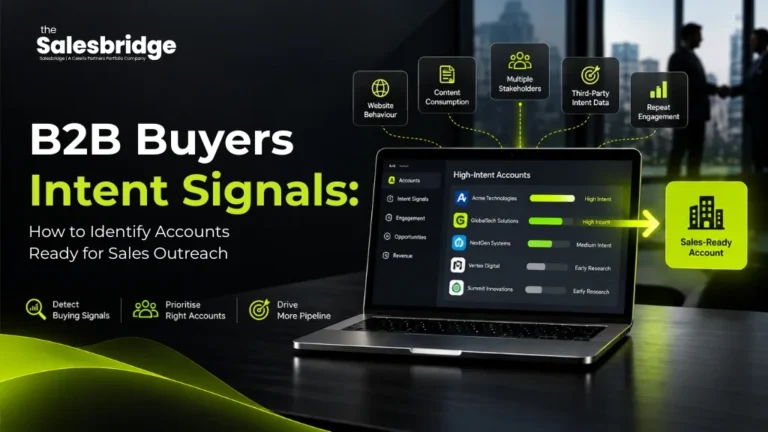
Start with revenue evidence rather than assumptions. Analyze closed-won and closed-lost accounts, deal size, sales cycle, industry, geography, technology environment, buying committee, and disqualifiers. Turn those findings into a tiered ICP and account universe. Intent sources such as 6sense, ZoomInfo, and Apollo can support research and prioritization, but no platform guarantees accuracy or purchase intent. Every record should be checked for role, company status, geography, source, freshness, and lawful-use constraints.
The output is an account-and-contact map with a reason to engage. For example, a target account may have expanded into a new region, hired a relevant executive, adopted a complementary platform, published a business initiative, or registered for a relevant event. The signal should shape the message, not merely justify adding the account to a sequence.
Build a coordinated sequence across the channels the audience actually uses. Cold email can introduce a specific business hypothesis; LinkedIn can provide context and credibility; content syndication or a webinar can create a lower-friction conversion path; and a phone call can clarify whether the problem is active. Each touch should have a distinct purpose and an exit condition.
Avoid treating automation as personalization. A useful message contains account-relevant context, a credible reason for contact, a concise value hypothesis, and a low-friction next step. The sequence must also honor suppression lists and channel-specific rules. The team should test subject lines, opening hypotheses, calls to action, persona angles, and timing while holding audience quality constant.
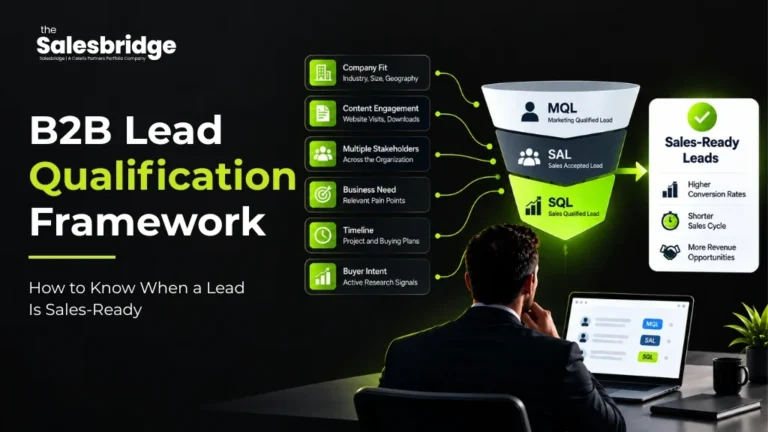
Agree on definitions before launch. An MQL may have engaged with marketing, but an HQL should show a stronger combination of fit, problem relevance, timing, and willingness to continue. An SQL should meet the sales team’s acceptance criteria and be ready for a defined next step. Use a qualification rubric that captures account fit, role, current state, business impact, initiative, timing, stakeholders, and agreed follow-up.
The goal is not to force every conversation into a qualification box. Good operators can mark “not now,” “wrong segment,” “existing solution,” “partner opportunity,” or “privacy objection” and return that structured information to marketing. Those outcomes improve targeting and protect the brand.
An appointment is qualified only when the invite, notes, account context, and next step reach the sales owner before the meeting. The handoff should include the triggering signal, contacts engaged, stated problem, current process or solution, relevant stakeholders, timing, agreed agenda, and any compliance or communication preference. The CRM should record disposition so the pod can learn from no-shows, disqualifications, opportunities, and closed revenue.
Set a service-level agreement for acceptance. For example, sales may have one business day to accept or reject a meeting with a reason code. Rejected meetings should not disappear into an argument about volume; they should become feedback that improves the ICP, script, and qualification threshold.
Optimize toward customer acquisition cost (CAC), pipeline contribution, and revenue not open rate alone. Review cost per accepted meeting, meeting-to-SQL rate, SQL-to-opportunity rate, opportunity-to-win rate, average contract value, sales-cycle length, sourced pipeline, influenced pipeline, and payback period. Segment results by account tier, persona, channel, message, geography, and operator.
A mature pod reallocates effort away from activities that create cheap but unqualified responses. It invests more in the combinations that produce accepted opportunities and learns from negative signals. This is where offshore execution becomes a strategic advantage: the client can add research, QA, campaign, and reporting capacity without expanding every internal management layer.
There is no universal offshore benchmark because ACV, category maturity, brand awareness, data quality, and the definition of “qualified” change the denominator. Use the following planning ranges to build a measurement model, then replace them with campaign-specific baselines after the first 30–60 days. These are not guarantees.
| Metric | Planning range for a focused B2B program | What to verify |
| Positive response rate | 1%–5% of delivered targeted outreach | Whether responses are relevant, not merely positive |
| Accepted-meeting rate | 4–12 accepted meetings per month per focused pod | ICP fit, role seniority, attendance, and sales acceptance |
| Cost per accepted meeting | $400–$1,500 in many mid-market motions | ACV, complexity, channels, data, and qualification depth |
| Meeting-to-SQL rate | 25%–50% | Definition of SQL and sales follow-up speed |
| SQL-to-opportunity rate | 20%–40% | Opportunity stage discipline and account fit |
| Hard-bounce rate | Keep as close to zero as practical; investigate spikes immediately | Verification, source quality, and suppression hygiene |
| Opt-out and complaint rate | Track by domain, source, persona, and message | Whether the campaign is reaching people who expect the contact |
The most useful dashboard separates activity, engagement, quality, pipeline, and economics. CPL is an acquisition metric, not a quality verdict. If one channel produces twice as many leads but half as many accepted opportunities, the cheaper CPL is not the better outcome. For CRO and VP-level decisions, report cost per accepted meeting and sourced pipeline alongside conversion rates and payback assumptions.
A practical 2026 planning range is approximately $400–$1,500 per accepted meeting for a focused B2B program, with complex enterprise, regulated, multilingual, or highly technical campaigns potentially higher. The figure depends on the monthly retainer, data and tooling included, channel mix, account tier, qualification standard, and meeting acceptance rate. A $750 meeting is not inexpensive if it produces no SQLs; it may be efficient if it creates qualified pipeline and revenue.
They should begin with documented roles and instructions, approved data sources, a lawful-basis assessment where personal data is used, privacy information, data-minimization rules, access controls, retention periods, suppression management, and an escalation path for objections or data requests. For live calls, UK teams should screen CTPS and TPS and honor internal do-not-call records. For corporate email, the PECR position is not the same as for sole traders and some partnerships, and UK GDPR can still apply to named business contacts. Counsel should review the specific campaign and any international data-transfer arrangements.
At minimum, the program needs a CRM as the system of record, a verified data and enrichment source, sequencing and email infrastructure, a calling or conversation system where lawful, LinkedIn or social-workflow controls, calendar scheduling, analytics, suppression management, and deliverability monitoring. The exact stack may include Salesforce or HubSpot, ZoomInfo, Apollo, 6sense, a sequencing platform, a dialer, and reporting tools. The important requirement is not the number of tools; it is clean ownership, synchronized opt-outs, auditable changes, and closed-loop revenue reporting.
Offshore demand generation can give US and UK B2B companies flexible capacity, broader coverage, and lower fixed cost than building every capability in-house. It will not, by itself, fix a weak ICP, unclear value proposition, poor data, slow sales follow-up, or undisciplined qualification. The winning model blends market-fluent strategy with efficient execution, treats compliance and deliverability as operating requirements, and measures success in accepted opportunities and pipeline economics.
For 2026 planning, ask a prospective partner to show the pod structure, data provenance, suppression workflow, sample qualification rubric, domain-protection process, CRM handoff, reporting cadence, and definitions behind every promised meeting. The right partner should be comfortable being measured on the quality and commercial value of pipeline not only on the number of activities completed.