Generating more B2B leads does not automatically create more sales opportunities. A prospect may download a whitepaper, attend a webinar or visit your pricing page without having an immediate need to purchase.
The challenge is determining when that interest becomes a genuine sales opportunity.
A B2B lead qualification framework helps marketing and sales teams make that decision using shared criteria. By evaluating account fit, business need, buying authority, timing, engagement and intent, companies can identify sales-ready leads without overwhelming sales teams with unqualified contacts.
For US and UK B2B companies managing complex buying journeys, consistent qualification is essential to building a more predictable pipeline.
A B2B lead qualification framework is a structured process for assessing whether a prospect matches your ideal customer profile, has a relevant business problem and demonstrates sufficient buying readiness to justify sales engagement.
Rather than relying on individual judgement or isolated marketing activities, it establishes consistent criteria for evaluating every lead.
Without clear qualification standards, marketing may consider a lead successful because someone completed a form, while sales may reject the same prospect because there is no immediate business need.
A shared framework helps both teams distinguish between early-stage interest and genuine buying readiness. It also connects lead generation with revenue performance, ensuring campaign success is measured beyond the number of contacts captured.
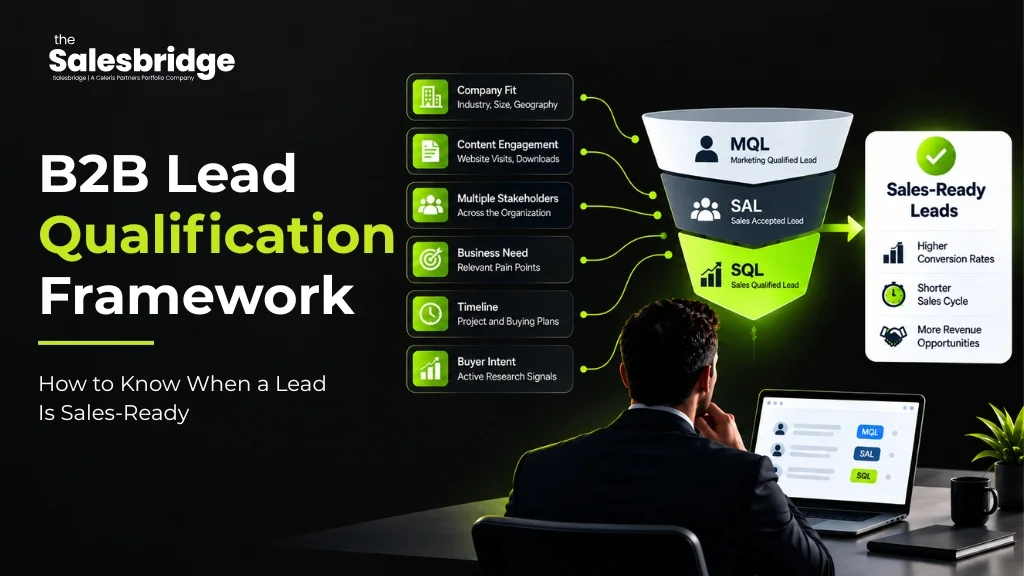
The distinction between a marketing-qualified lead and a sales-qualified lead is central to an effective qualification process.
An MQL is a prospect who matches agreed marketing criteria and demonstrates meaningful engagement.
This might include downloading relevant content, attending a webinar, repeatedly visiting solution pages or responding to a targeted campaign.
However, engagement alone does not confirm that the prospect has an active purchasing requirement.
A sales-accepted lead has been reviewed and accepted by sales for further qualification.
At this stage, the assigned representative confirms that the lead meets agreed handoff requirements and has sufficient information for relevant follow-up.
Sales acceptance establishes accountability between marketing and sales without prematurely classifying every accepted lead as an opportunity.
An SQL has undergone sales-led qualification and meets the company’s criteria for progressing into an active sales process.
Depending on the sales model, this may involve confirming a business problem, relevant stakeholders, purchasing timeframe and a realistic path toward investment.
The exact MQL, SAL and SQL definitions should be documented and agreed upon by both teams.
A practical B2B lead qualification framework should evaluate six interconnected factors rather than depend on one engagement score.
Begin by determining whether the company matches your ideal customer profile.
Assess its industry, company size, geographical location, business model, technology environment and potential requirement for your services.
For example, a US-based SaaS company targeting enterprise customers may qualify accounts differently from a UK IT services provider targeting mid-market businesses.
A prospect showing strong interest but falling outside your ICP may not justify immediate sales engagement.
A qualified prospect should have a problem your business can realistically solve.
Identify the operational challenge, commercial objective or growth requirement motivating the enquiry.
Understanding the need helps sales distinguish genuine demand from general curiosity and develop a relevant conversation.
Determine whether your contact can make a purchasing decision, influence the decision or introduce the relevant stakeholders.
In complex B2B purchases, authority rarely belongs to one individual.
A marketing manager researching demand generation services may initiate the process, while a marketing director, finance representative or executive approves the investment.
Timing helps determine whether a prospect requires immediate outreach or continued nurturing.
A company evaluating vendors for an upcoming project may warrant a different response from one exploring options for the following year.
An undefined timeline should not automatically disqualify a high-fit prospect. It should influence the next action.
Engagement shows how a prospect interacts with your brand.
Review relevant website visits, content downloads, webinar attendance, email responses and previous conversations.
Prioritise meaningful actions over superficial activity. A direct request for a consultation generally provides more actionable context than several email opens.
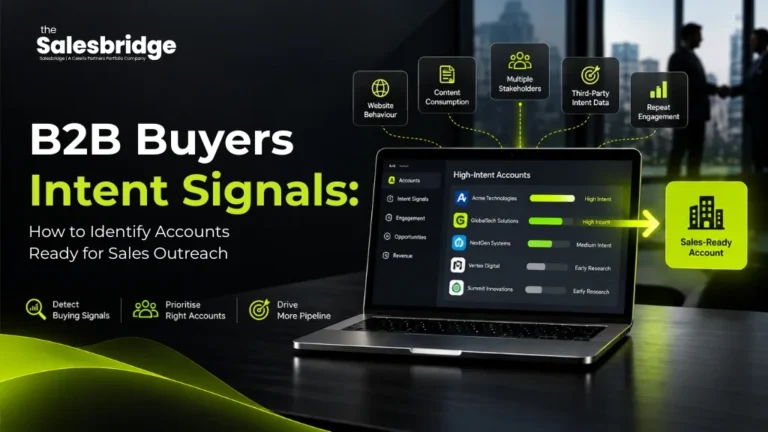
Buyer intent provides additional context about the topics and solutions an account is actively researching.
Combine first-party engagement with relevant external research, account-level activity and recent buying signals.
For a deeper explanation, explore our guide to B2B buyer intent signals and identifying sales-ready accounts.
BANT is a widely used framework for assessing Budget, Authority, Need and Timeline. It provides a consistent structure for sales discovery.
Budget qualification should establish whether the organisation has a realistic path to funding the proposed solution.
An approved budget is useful, but some prospects begin researching before funding has been allocated.
Similarly, authority qualification should identify the decision-making process rather than require every initial contact to be the final decision-maker.
Need and timeline help determine the commercial relevance and urgency of an opportunity.
Ask what prompted the prospect to explore solutions, which business outcome matters and whether an internal deadline is influencing the project.
Use BANT to guide discovery conversations, not as a rigid checklist that excludes potentially valuable accounts too early.
Lead scoring helps marketing prioritise prospects consistently before passing them to sales.
An effective model combines account characteristics with behavioural engagement and buying intent.
Assign fit scores based on ICP characteristics such as industry, company size, geography and relevant job roles.
Evaluate engagement separately using meaningful activities, including solution-page visits, webinar participation, direct enquiries and content interactions.
This prevents a poor-fit prospect from qualifying simply by downloading multiple resources.
Define the minimum criteria required for a lead to become an MQL.
For example, an account may need to satisfy mandatory ICP requirements and demonstrate at least one meaningful engagement or intent signal.
Higher-priority actions, such as requesting a consultation, can trigger immediate review without waiting for an arbitrary score.
Review thresholds against actual sales acceptance and conversion data rather than treating the initial scoring model as permanent.
Even a well-designed B2B lead qualification framework can fail when marketing and sales operate with different definitions of readiness.
A documented handoff process establishes what information must accompany each lead, who owns the next action and how quickly sales should respond.
Before transferring a lead, marketing should provide the account’s ICP fit, contact information, relevant engagement history, identified business need and available intent signals.
Sales should then accept, reject or return the lead with a documented reason.
For example, a rejected lead may have an unsuitable company profile, incomplete contact information or insufficient purchasing readiness.
Review rejected leads and stalled opportunities to identify recurring qualification problems.
If sales repeatedly rejects leads from a particular campaign, investigate whether the targeting, messaging or qualification criteria need adjustment.
A structured B2B revenue operations and lead management process can help connect qualification, routing, CRM ownership and follow-up.
The effectiveness of a qualification framework should be assessed using pipeline outcomes, not MQL volume alone.
Monitor MQL-to-SQL conversion, sales acceptance rate, SQL-to-opportunity conversion and the time between qualification and first sales contact.
Analyse these metrics by campaign, channel, geography and target account segment.
Compare qualified lead volume with opportunity creation, pipeline value and closed revenue.
A campaign generating fewer leads may still contribute more pipeline if those prospects consistently meet your qualification criteria.
For companies scaling campaigns across the US and UK, this visibility helps marketing and sales identify which audiences and programmes generate commercially relevant demand.
A B2B lead qualification framework is a structured process for determining whether a prospect fits your target customer profile and demonstrates sufficient business need, engagement and purchasing readiness to progress toward sales.
An MQL meets agreed marketing qualification criteria based on fit and engagement. An SQL has undergone sales-led qualification and meets the organisation’s requirements for entering an active sales process. Some businesses use an intermediate sales-accepted lead stage to formalise the handoff.
BANT evaluates Budget, Authority, Need and Timeline. It helps sales teams understand whether a prospect has a relevant business problem, access to decision-makers, a realistic funding path and an appropriate purchasing timeframe.
A sales-ready lead generally matches the ideal customer profile, has a relevant business requirement and demonstrates enough engagement or buying intent to justify direct sales contact. The exact threshold depends on the company’s sales process and agreed qualification criteria.
Start by aligning marketing and sales around shared MQL and SQL definitions. Combine ICP fit with engagement and buyer intent, introduce consistent lead scoring, document sales acceptance criteria and regularly review conversion and rejection data.
A reliable qualification process begins with reaching the right audience and continues through meaningful engagement, accurate lead data and timely sales follow-up.
The Salesbridge helps US and UK B2B companies connect demand generation, lead generation, account-based marketing, content syndication and qualified sales engagement to support measurable pipeline growth.
Whether your team needs better-qualified prospects, more consistent campaign execution or stronger alignment between marketing and sales, we can help you build a demand generation approach around your target accounts.
Looking to generate more qualified B2B leads and improve your sales pipeline?
Explore The Salesbridge’s demand generation services and discuss your growth objectives with our team.