B2B sales teams rarely struggle because there are no potential customers. The bigger challenge is knowing which accounts are actively researching a solution and when they are most likely to engage with sales.
This is where B2B buyer intent signals become valuable. Instead of treating every lead or target account equally, marketing and sales teams can use website behaviour, content engagement, research activity, account-level signals, and buyer intent data to identify businesses showing meaningful buying interest.
The goal is not to predict exactly when a company will purchase. It is to understand which accounts deserve attention now, which should remain in nurture, and which activity is simply general research.
For B2B companies selling complex products or services, this approach can make demand generation and sales outreach more timely and relevant.
B2B buyer intent signals are observable behaviours or data points that indicate a company may be researching a problem, evaluating solutions, or moving closer to a purchasing decision.
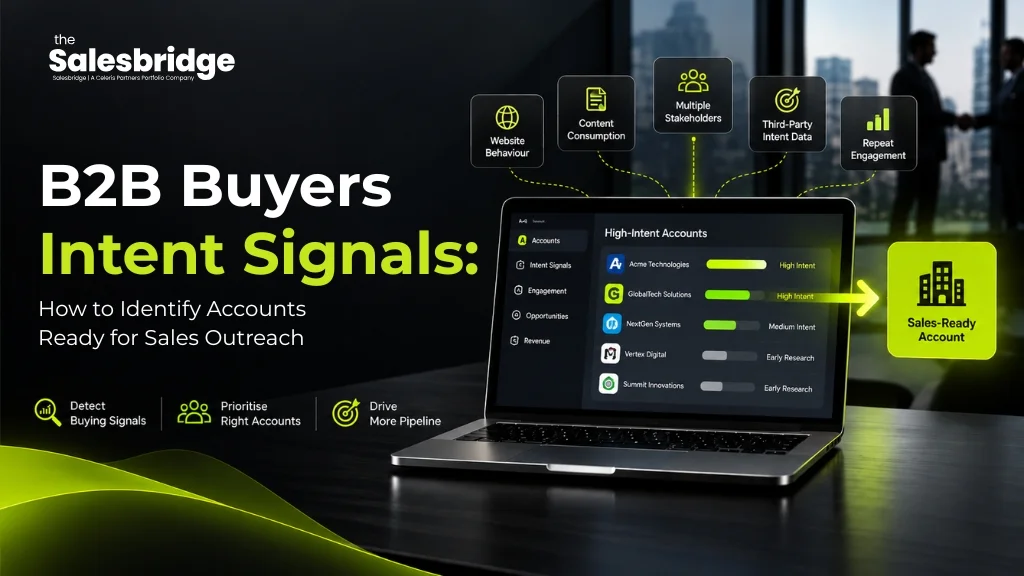
These signals can come from a company’s own digital properties or from external research activity. Examples include repeated visits to service pages, pricing-page activity, downloads of product content, webinar participation, competitor research, or several employees from the same company engaging with related topics.
However, intent should not be treated as proof that an account is ready to buy.
A company visiting a pricing page once does not automatically mean a sales conversation should begin. The value comes from identifying patterns of intent, combining them with account fit and evaluating how recently the activity occurred.
One of the most important principles of intent-based marketing is that interest is directional.
A company may research a topic because it is educating employees, comparing vendors, preparing a future project, or simply exploring the market. Strong buying signals become more meaningful when multiple behaviours occur together.
For example, repeated website visits from several employees, engagement with solution-specific content, and research around a relevant category can provide more context than a single page visit.
B2B buying journeys can take weeks or months. If sales teams contact an account too early, the prospect may not have a business reason to respond. If outreach happens after the buying process is already advanced, competitors may already be involved.
B2B intent signals help marketing and sales teams recognise changes in account activity and decide when an account deserves closer attention.
Traditional lead generation often focuses on collecting names, email addresses, company information, and other contact details.
That information is useful, but it does not necessarily explain why the prospect should be contacted now.
Buyer intent adds behavioural context to the profile.
For example, two companies may have similar firmographic characteristics. Both may fit the ideal customer profile, but only one may currently be researching solutions related to your offering.
That difference can help revenue teams allocate sales resources more effectively.
A static lead list tells sales who exists.
Intent data can help indicate who is showing relevant activity.
This changes the sales process from simply working through a database to prioritising accounts based on a combination of fit, behaviour, engagement, and timing.
For organisations already investing in B2B demand generation, intent signals can also help connect marketing activity with sales execution.
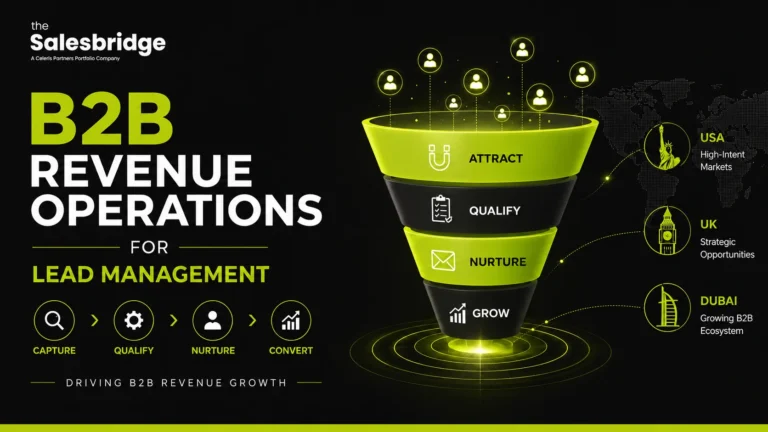
The Salesbridge’s approach to B2B revenue operations and lead management highlights the importance of connecting marketing activity, lead management, and sales follow-up rather than treating each function separately.
Marketing may see content engagement, website activity, webinar participation, or campaign responses.
Sales may see conversations, account research, CRM activity, and prospect responses.
When these signals are connected, revenue teams can build a clearer picture of account activity and determine whether an opportunity deserves immediate sales attention or continued nurturing.
Not every signal has the same meaning. The most useful approach is to monitor several behaviours and evaluate them together.
Website activity is one of the most accessible first-party intent signals.
Repeated visits to service pages, product pages, pricing information, comparison pages, case studies, or contact pages can indicate growing interest.
The context matters. Someone reading a general industry blog is at a different stage from someone repeatedly visiting a solution page and reviewing pricing information.
Content can reveal what an account is trying to understand.
A prospect consuming educational content around an industry problem may still be in the awareness stage. Someone engaging with comparison guides, implementation content, case studies, or solution-specific material may be further into the evaluation process.
Content engagement becomes more useful when it is mapped to specific buying stages.
One visit provides limited context.
Repeated engagement over several days or weeks can provide a stronger indication that a topic is relevant to the account.
Recency also matters. Recent activity generally provides more actionable context than engagement that happened several months ago.
One of the stronger account-level B2B intent signals is engagement from multiple people within the same organisation.
If employees from marketing, IT, operations, finance, or leadership are researching related topics, it may indicate that the issue is being discussed across the organisation.
This is particularly important for B2B products where purchasing decisions involve multiple stakeholders.
Third-party buyer intent data can provide information about research happening outside your own website.
This can include category research, competitor comparisons, industry topics, product research, and activity across relevant content or review environments.
Third-party intent can help identify accounts that may not yet have visited your website, giving marketing teams an opportunity to create awareness before direct engagement occurs.
Understanding the difference between first-party and third-party intent is important when building an intent strategy.
First-party signals come from interactions with your own digital properties.
Examples include website visits, content downloads, webinar registrations, email engagement, demo requests, pricing-page activity, and interactions with sales or marketing campaigns.
The major advantage is context. You know exactly what the account interacted with and when.
Third-party intent provides visibility into research activity occurring outside your owned channels.
For example, an account may be researching a business category, comparing providers, reading industry content, or evaluating alternatives before ever visiting your website.
This information can expand your view of the buying journey.
Using only first-party data can mean missing accounts that are researching but have not yet engaged with your brand.
Using only third-party intent can create uncertainty because you may not know exactly how the account interacted with your company.
Combining first-party engagement, third-party research, CRM information, firmographic fit, and sales activity provides a more complete account picture.
The biggest mistake businesses make with intent data is treating every signal as a sales opportunity.
Intent should be evaluated in context.
A single action rarely tells the complete story.
Consider an account that matches your ICP, has recently visited several solution pages, downloaded a relevant resource, and has multiple employees engaging with related content.
That pattern is more meaningful than one isolated page visit.
The same principle applies to third-party research. A sudden increase in category research becomes more useful when the account also fits your target market and shows engagement with your brand.
Fresh activity generally deserves more attention than old activity.
Frequency can also provide context. Repeated engagement over a short period may indicate an active research cycle, while occasional engagement over several months may simply reflect ongoing education.
Intent without fit can waste sales resources.
An account may show extremely high activity but still fall outside your target industry, company size, geography, technology environment, or buyer profile.
That is why sales-ready accounts should be evaluated using both behavioural signals and business fit.
A practical way to operationalise B2B buyer intent signals is to evaluate three dimensions: fit, intent, and engagement.
Start with your ideal customer profile.
Consider company size, industry, geography, revenue range, technology environment, business model, and relevant decision-maker roles.
The objective is to identify whether the account is commercially relevant before interpreting its activity.
Next, evaluate the strength and type of buying signals.
Look at research topics, website behaviour, content activity, competitor research, solution-page visits, and changes in account-level activity.
Determine whether the account has interacted with your brand.
Engagement can include website visits, content downloads, webinar participation, email responses, social interactions, or previous sales conversations.
The combination of these three factors creates a more useful sales-prioritisation model.
A high-fit account showing strong intent and meaningful engagement may deserve immediate sales review.
A high-fit account showing emerging intent but limited engagement may be better suited to targeted demand generation and nurturing.
An account showing high activity but poor ICP fit may require validation before sales resources are assigned.
Intent data only creates value when it changes what the revenue team does.
Sales teams can use intent signals to prioritise accounts, research relevant business context, and make outreach more specific.
Instead of sending a generic message such as “I wanted to introduce our services,” the salesperson can build outreach around a relevant business problem, industry challenge, or recent account activity.
The objective is not to reveal private browsing behaviour or overwhelm the prospect with evidence of tracking. It is to use available business context to make the conversation more relevant.
A strong marketing-to-sales handoff should also include the reason an account has been prioritised, the relevant signals, the account’s ICP fit, previous engagement, and recommended next action.
B2B demand generation is not only about generating more leads. It is about creating and capturing demand from the right accounts and moving them toward revenue.
Buyer intent can strengthen this process by helping marketers understand which accounts are researching relevant problems and which accounts may require more education.
For example, an account showing early-stage research can receive educational content, while an account showing stronger solution-level intent can receive case studies, comparison content, webinars, or sales engagement.
This creates a more coordinated approach across awareness, consideration, qualification, and sales outreach.
For companies looking to extend their demand generation capabilities, offshore demand generation for US and UK B2B companies can also be part of a broader model for scaling campaign execution and qualified pipeline generation.
Similarly, content can be used to reach decision-makers earlier in the buying process. A structured B2B content syndication strategy can help businesses distribute relevant content to targeted audiences and generate additional engagement signals.
B2B buyer intent signals are observable behaviours that indicate an account may be researching a business problem, evaluating solutions, or moving closer to a purchasing decision. Examples include website activity, content engagement, repeat visits, competitor research, and multiple stakeholders engaging with related topics.
Buyer intent data provides information about research and engagement activity that can indicate potential buying interest. It can include first-party data from your own website and marketing channels as well as third-party research activity from external sources.
Strong signals generally become more meaningful when several behaviours occur together. Recent solution-page activity, pricing or demo engagement, repeated visits, multiple stakeholders from the same account, relevant external research, and strong ICP fit can provide useful context for sales prioritisation.
Sales teams can use intent signals to prioritise accounts, understand relevant business context, personalise outreach, and coordinate follow-up with marketing. Intent should support sales judgement rather than replace account research or qualification.
No. Buyer intent indicates interest or research activity, not a guaranteed purchase. The most useful approach is to combine intent with ICP fit, engagement, recency, frequency, CRM information, and other qualification criteria before deciding how to approach an account.
The value of B2B buyer intent signals is not simply identifying companies that are researching a topic. The real opportunity is connecting those signals with account fit, engagement, qualification, and timely sales action.
When marketing and sales teams share the same account-level view, they can spend less time treating every lead equally and more time understanding where meaningful buying activity is taking place.
For B2B companies targeting the US and UK markets, The Salesbridge combines AI-powered demand generation, lead generation, account-based marketing, content syndication, and sales-focused campaign execution to help businesses turn demand signals into qualified pipeline.
If your team wants to build a more predictable process for identifying, qualifying, and engaging high-intent B2B accounts, talk to The Salesbridge about your demand generation goals.