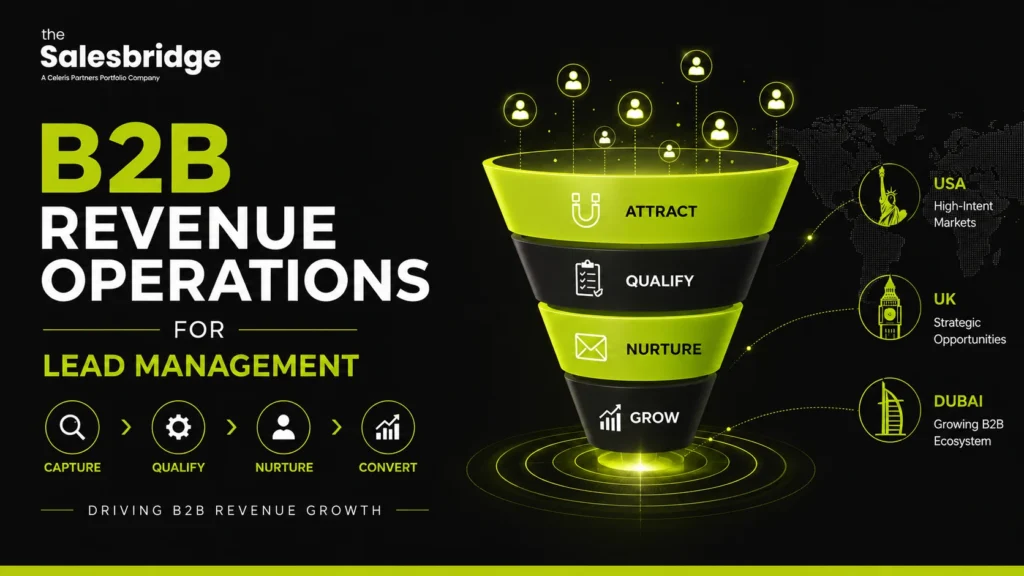
B2B Revenue Operations connects demand generation with lead capture, enrichment, qualification, routing, follow-up, pipeline management, and revenue reporting. For businesses and brands targeting the USA, UK, and Dubai, an effective RevOps process combines shared data and qualification standards with market-specific ownership, time-zone coverage, workflows, and reporting. Platforms such as HubSpot, Salesforce, and Salesloft can support this process when their roles, data fields, integrations, and responsibilities are clearly defined.
Generating B2B leads is only the beginning of the revenue journey. A form submission, event registration, content download, or consultation request creates potential value, but it does not automatically create qualified pipeline. The lead must be captured accurately, matched to the right account, enriched, qualified, routed, followed up, and measured.
That is where Demand Generation-to-Revenue Operations becomes important. Demand generation creates awareness and interest. Lead management turns that interest into an organised sales or nurture process. Revenue Operations connects the people, systems, processes, data, and reporting that move the lead toward measurable commercial outcomes.
For B2B businesses and brands targeting the USA, UK, and Dubai, the challenge is more complex than simply collecting more contacts. Teams must account for regional ownership, time zones, business schedules, industry segments, local messaging, consent preferences, and different sales coverage models. A well-designed RevOps framework creates common standards without forcing every market to operate identically.
B2B Revenue Operations, commonly called RevOps, is the operating model that aligns marketing, sales, customer success, systems, processes, data, and reporting around one revenue journey. It is broader than CRM administration and more practical than a collection of disconnected software tools.
A RevOps function helps answer questions such as:
Which activities are generating qualified demand?
What makes a lead sales-ready?
Which system owns each piece of data?
How quickly should a lead be assigned and followed up?
Which representative or team should receive the lead?
How are marketing and sales measuring the same pipeline?
Where are leads, opportunities, or data records being lost?
Revenue Operations typically manages process design, CRM data quality, lifecycle stages, lead qualification, lead routing, marketing-to-sales handoffs, reporting, attribution, pipeline administration, forecasting support, and workflow governance.
The goal is not to make every team use the same tool in exactly the same way. The goal is to create a reliable operating system in which each team understands its role and every important handoff can be monitored.
These three functions are closely connected, but they do different jobs.
Demand generation creates awareness, engagement, and interest among target accounts. It may include search, content, social media, paid media, email, events, webinars, partnerships, account-based marketing, and outbound campaigns.
Effective demand generation begins with a clear ideal customer profile. The business should know which industries, company sizes, markets, use cases, and buyer roles it wants to reach. For campaigns targeting the USA, UK, and Dubai, messaging and channel selection should reflect the business priorities and buying context of each target market.
Lead management captures, validates, enriches, qualifies, routes, and follows up with potential buyers. It determines whether a contact should be sent to sales, placed into nurture, assigned to an account-based workflow, or disqualified against documented criteria.
Lead management is the bridge between marketing activity and sales execution. Without it, high-intent leads may wait in a queue, reach the wrong representative, receive irrelevant messaging, or disappear from reporting.
Revenue Operations governs the people, data, processes, systems, and reporting behind the revenue lifecycle. It ensures that demand generation and lead management are connected to pipeline creation, opportunity progression, forecasting, and revenue analysis.
The relationship can be summarised simply:
Demand generation creates interest → lead management creates sales readiness → Revenue Operations creates process control and revenue visibility.
Lead leakage rarely comes from one major failure. It usually develops through several small weaknesses that compound over time.
A record may be missing the company website, country, job title, business email, industry, company size, service interest, lead source, or account owner. Incomplete information makes it difficult to assess fit or apply routing rules accurately.
Duplicate records create another problem. If the same person exists in multiple systems, the business may send conflicting messages, assign the lead to different representatives, or fail to recognise an existing customer or opportunity.
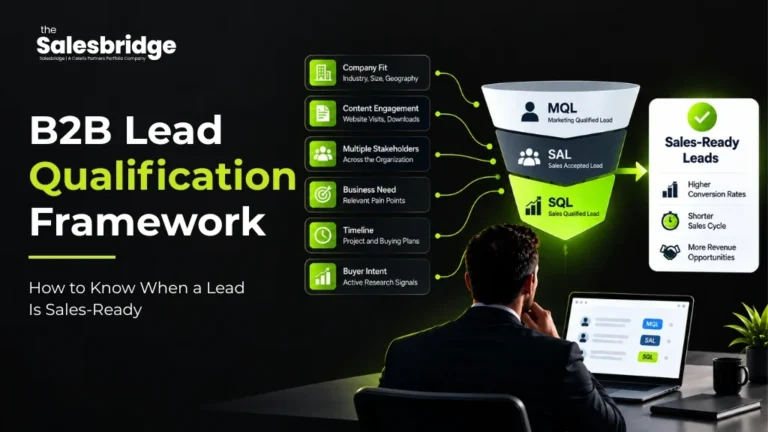
Marketing and sales may use the same terms but mean different things. A marketing-qualified lead may represent engagement, while sales may expect clear fit, business need, authority, timing, and a defined next action.
A qualification stage should have observable entry and exit criteria. It should not depend solely on a score or a label selected according to personal preference.
Manual assignment creates avoidable delays and ownership conflicts. A lead may be routed to the wrong country, an inactive representative, a general queue, or someone who does not own the existing account.
A robust routing process checks existing customers and open opportunities before applying round-robin or general territory rules. It also includes a fallback queue for missing information, inactive owners, and workflow failures.
A sales representative should not receive only a name and an email address. A useful handoff includes the lead source, campaign, engagement history, business challenge, relevant service, target market, qualification context, recommended next step, and follow-up deadline.
Sales feedback should also return to marketing and RevOps. If sales repeatedly rejects leads from a particular campaign or segment, the qualification rules and demand-generation strategy may need adjustment.
A connected RevOps stack does not require every system to store every field. Each platform should have a defined purpose, system-of-record rules, synchronisation direction, exception process, and accountable owner.
| Platform | Example role in the revenue workflow |
| HubSpot | Marketing automation, campaign engagement, forms, lifecycle signals, lead capture, and nurture workflows. |
| Salesforce | Accounts, contacts where applicable, opportunities, ownership, sales stages, pipeline, and forecast management. |
| Salesloft | Eligible sales-engagement cadences, tasks, replies, activity execution, and sequence reporting. |
| Enrichment or intent platform | Firmographic, technographic, account-priority, and buying-signal data. |
| Reporting or BI layer | Reconciled performance reporting across campaigns, leads, opportunities, and revenue. |
For example, a HubSpot form submission may create or update a contact, match the contact to an account, validate the target market and persona, enrich the record, assign an owner in Salesforce, and enrol the contact in an appropriate Salesloft cadence only when eligibility rules are met.
That workflow needs safeguards. For example, the email domain may match an existing account even when the contact is new. An open opportunity may already exist, requiring the lead to remain with the current account owner. Marketing opt-outs must also prevent inappropriate enrolment in campaigns or sales cadences. If a synchronisation fails, the record should enter an exception queue for review. Documenting these scenarios prevents sellers from discovering problems after the handoff.
Platform note: Salesforce, HubSpot, Salesloft, and Outreach are third-party platforms. This article describes potential workflows involving these tools; the exact implementation depends on the client’s subscription, configuration, permissions, data model, integration method, and applicable terms.
A practical lead-management process follows this sequence:
Generate → Capture → Enrich → Qualify → Route → Follow up → Manage → Measure
Define the ideal customer profile, target industries, company sizes, buyer roles, markets, and commercial problems. Create messaging that is relevant to the audience and the target market. Track campaign, source, content, channel, and engagement data from the beginning.
Use website forms, landing pages, consultation requests, chat, events, email, webinars, and campaign responses to capture demand. Collect the information required for qualification and routing, while avoiding unnecessary fields that reduce conversion.
Separate high-intent actions, such as requesting a consultation or demonstration, from lower-intent activities, such as downloading introductory content. Both may be valuable, but they should not automatically receive the same sales treatment.
Verify contact details, complete company information, match the person to the correct organisation, identify duplicates, check for existing customers and open opportunities, and standardise market, industry, and company-size fields.
Use confidence thresholds where possible. High-confidence matches may be automated. Medium-confidence matches should enter a review queue. Low-confidence or strategically important records should be escalated rather than guessed.
Assess the lead against agreed criteria, including ICP fit, business need, buying intent, authority, timing, service relevance, commercial potential, and existing account status.
A lead does not need to be sent to sales simply because it has completed a form. It should enter the next appropriate path: sales follow-up, nurture, account-based research, partner engagement, or disqualification.
Assign leads according to existing account ownership, market, region, industry, company size, service interest, account priority, lead score, and representative availability.
For USA, UK, and Dubai campaigns, routing should reflect regional coverage windows, public holidays, language requirements, escalation contacts, and local ownership. Dubai is part of the UAE, so the article and campaign documentation should distinguish Dubai-specific targeting from wider UAE or regional coverage where relevant.
Notify the assigned owner, create a follow-up task, provide the qualification context, monitor the response SLA, and escalate unhandled leads. The business should measure each stage of the response process: lead creation, assignment, notification, and first sales action.
Research published by Harvard Business Review found that many companies were not responding to online enquiries quickly enough and highlighted the importance of response speed in connecting with potential buyers. The practical lesson is that the response clock begins when meaningful intent is captured, not when someone eventually opens the CRM.
Sales-ready leads may become opportunities. Leads that are not ready should enter a relevant nurture or education path. Leads that do not fit the agreed criteria should be disqualified with a documented reason.
Lifecycle stages should be updated as the relationship develops. Stale stages and missing next steps make both seller execution and leadership reporting less reliable.
Review performance by market, source, campaign, segment, service interest, and owner. Analyse response time, routing accuracy, sales acceptance, meetings, opportunities, pipeline, and revenue contribution.
The process should improve through feedback. If a lead source generates volume but low sales acceptance, the issue may be targeting, qualification, messaging, routing, or follow-up—not simply sales effort.
A common qualification framework creates consistency, while market-specific rules provide relevance.
Use industry, company size, revenue range, business model, buyer role, location, business challenge, relevant service, buying timeline, engagement level, and existing account status. These fields should have documented definitions and accepted values.
USA campaigns may require time-zone-based ownership, state or regional coverage, named-account rules, industry specialisation, and representative availability. Lead forms and routing rules should capture enough information to distinguish the intended market from a general international enquiry.
UK campaigns should account for local business hours, account ownership, territory assignment, communication preferences, and applicable privacy and electronic-marketing requirements. The organisation should document how business contacts, individual contacts, consent, opt-outs, and suppression lists are handled.
Dubai-focused campaigns should clarify whether the target is Dubai-based businesses, the wider UAE, or a broader Middle East market. Qualification may include sector relevance, local account ownership, regional working schedules, market-appropriate messaging, and the buyer’s preferred communication channel.
ICP definitions, core qualification criteria, data standards, lifecycle stages, ownership fields, reporting structures, sales-acceptance processes, and escalation rules should remain consistent wherever possible. Regional adaptations should be documented rather than implemented informally.
A practical routing hierarchy is:
Checking account ownership first protects existing relationships, prevents duplicate outreach, and keeps open opportunities with the correct owner. This rule is particularly important when the same organisation operates across multiple locations or markets.
Round-robin routing may work when leads have similar value, representatives have comparable responsibilities, territories are simple, and there are no account-ownership conflicts. It should not be the default for every lead.
Fallback rules should cover missing region, missing company information, duplicate records, inactive owners, unavailable representatives, workflow failure, and missed response SLAs. Every unassigned lead should have a reason code and an accountable owner.
Store the assigned owner, market, routing category, assignment timestamp, assignment reason, follow-up deadline, SLA status, and escalation status. This creates an audit trail and allows RevOps to measure routing quality rather than relying on anecdotal complaints.
A regional workflow should distinguish between business-hours coverage, extended operational coverage, follow-the-sun coverage, and continuous 24-hour monitoring. Use only the description the business can consistently provide.
“24-hour operational coverage” can refer to monitoring, data enrichment, exception handling, routing, CRM maintenance, and reporting across defined coverage windows. It should not imply a guaranteed live sales conversation at every hour unless that service is genuinely offered and documented.
Create market-specific queues for the USA, UK, Dubai/UAE, strategic accounts, partner leads, nurture leads, and unassigned or exception leads. Display the lead’s local time where possible and define handoff rules between regional teams.
The objective is not to make every market identical. It is to prevent a lead from being lost simply because it arrived outside one team’s normal working period.
A qualified handoff should give the receiving representative enough context to act without repeating the entire discovery process.
| Handoff category | Recommended information |
| Contact and account | Company name, website, contact name, job title, business email, market, company size, and industry. |
| Marketing and engagement | Lead source, campaign, pages visited, content downloaded, event participation, and previous interactions. |
| Qualification | Business challenge, relevant service, buying stage, decision-making role, expected timeline, fit, and qualification status. |
| Sales action | Assigned owner, recommended next step, follow-up deadline, escalation rule, previous conversations, and preparation required. |
The handoff should also communicate why the lead was assigned. This is especially useful when routing is based on a named account, regional ownership, industry specialisation, or a specific service interest.
Consider a consultation request from a US-based operations leader.
First, the enquiry is captured through a website form and assigned a source and campaign. The record is checked for required information, enriched with company details, and reviewed for duplicates. The system then checks whether the organisation is an existing customer, named account, or open opportunity.
Next, the lead is assessed against the ICP and qualification criteria. If it meets the agreed threshold, it is routed to the correct owner based on account ownership, market, industry, service interest, and availability. The representative receives the qualification context and a follow-up task. If the lead is not ready, it enters a relevant nurture path. If it does not fit, the reason is recorded for reporting.
A UK or Dubai/UAE lead would follow the same core process but may use different ownership, working-hour, messaging, escalation, and communication rules. The data model remains consistent while the regional execution is adapted.
Workflow summary:
Capture → Enrich → Qualify → Route → Notify → Follow up → Convert or Nurture → Report
Metrics should connect operational performance to business outcomes.
Track data-validation rate, duplicate-record rate, account-matching rate, enrichment-completion rate, lead-source completeness, and required-field completion.
Track time to assignment, time to first response, routing accuracy, unassigned-lead rate, SLA compliance, lead acceptance rate, and escalation rate.
Track lead-to-meeting conversion, marketing-qualified-to-sales-qualified conversion, sales-qualified-to-opportunity conversion, opportunity-to-customer conversion, and lead-to-pipeline conversion.
Track marketing-sourced pipeline, pipeline by market, revenue by lead source, pipeline velocity, customer-acquisition cost, and campaign contribution to revenue.
Lead volume and response speed should not be presented as standalone measures of success. A high-volume campaign that produces poor-fit leads may create more work without creating more pipeline. Operational improvements should ultimately be connected to sales acceptance, meetings, opportunities, pipeline, and revenue.
| Mistake | Business impact | Recommended improvement |
| Treating every lead equally | High-value and low-intent leads receive the same process. | Use ICP fit, intent, service interest, and account priority. |
| Using round-robin routing for every lead | Existing account ownership and strategic accounts may be ignored. | Check account and opportunity ownership first. |
| Routing before enrichment | Leads may be assigned to the wrong market or representative. | Validate essential information before assignment. |
| Measuring lead volume only | Marketing activity may look strong while pipeline remains weak. | Track acceptance, meetings, opportunities, pipeline, and revenue. |
| Using inconsistent lifecycle definitions | Marketing, sales, and leadership interpret the funnel differently. | Define lead, MQL, SQL, opportunity, nurture, and disqualified stages. |
| Failing to monitor exceptions | Unassigned, duplicated, or failed records remain invisible. | Create fallback queues, alerts, escalation workflows, and audits. |
| Treating international markets identically | Regional ownership, schedules, messaging, and governance may be unsuitable. | Maintain common standards while adapting documented market rules. |
An integrated Demand Generation-to-Revenue Operations solution may be useful when lead follow-up is inconsistent, CRM data is unreliable, routing remains manual, marketing and sales disagree about lead quality, reporting is delayed, or the business is expanding into new markets.
The solution may include demand-generation planning, lead data enrichment, account research, qualification, routing, CRM updates, sales-follow-up coordination, pipeline administration, reporting, dashboard maintenance, and process documentation.
Before an engagement begins, define the scope of work, target markets, qualification criteria, routing rules, system access, data-governance responsibilities, service levels, reporting frequency, escalation process, and success metrics.
The strongest operating model keeps strategic ownership with the client’s leadership while assigning clear responsibility for execution. The CRO, CMO, or Head of Sales Operations should approve commercial priorities and material process changes. The RevOps function should own the agreed workflow, monitoring, documentation, testing, reporting, and exception management.
Map all lead sources, systems, handoff points, campaign fields, lifecycle stages, routing rules, and reports. Review data quality and identify unassigned, rejected, duplicate, and stalled leads.
Confirm the ICP, qualification criteria, lifecycle stages, routing hierarchy, response SLAs, escalation rules, market queues, and system-of-record responsibilities.
Standardise required fields, configure routing workflows, create regional queues, test USA, UK, and Dubai/UAE scenarios, and test duplicate, missing-data, inactive-owner, opt-out, and workflow-failure cases.
Launch lead-management dashboards, review SLA performance, analyse rejected and unassigned leads, collect sales feedback, and update routing and qualification rules.
B2B Revenue Operations is the operating model that connects marketing, sales, customer success, data, systems, processes, and reporting around one measurable revenue journey. It manages the handoffs between demand generation, lead management, sales engagement, pipeline administration, forecasting, and revenue reporting.
RevOps defines the data, lifecycle stages, qualification criteria, routing rules, ownership, follow-up SLAs, exception processes, and reporting used to manage leads. It helps ensure that a lead is captured accurately, matched to the right account, routed to the right owner, followed up appropriately, and measured through the funnel.
Demand generation creates awareness, engagement, and qualified interest through channels such as search, content, events, paid media, social media, email, and outbound campaigns. Revenue Operations governs the systems and processes that turn that interest into organised lead management, sales activity, pipeline, forecasting, and revenue visibility.
They can support connected workflows through native connectors, middleware, APIs, and documented processes, depending on the client’s configuration, permissions, subscription, data model, and integration requirements. The platforms should have clearly defined roles and field ownership so that data does not become duplicated, overwritten, or disconnected.
Use common qualification standards but adapt ownership, time zones, business hours, industry coverage, language, account status, communication preferences, and escalation rules for each target market. Existing account ownership and open opportunities should generally be checked before applying territory or round-robin rules.
Useful information includes industry, company size, business model, buyer role, location, business challenge, relevant service, buying timeline, engagement level, account status, and evidence of fit with the ideal customer profile. The exact fields should reflect the company’s sales process and should not collect unnecessary information.
No. High-intent, well-qualified leads may be routed directly to sales, while lower-intent or incomplete leads may require nurture, enrichment, account research, or additional qualification. Documented criteria help prevent sales teams from receiving a large volume of poor-fit leads.
No. Round-robin can work where leads are similar in value, territories are simple, representatives have comparable responsibilities, and account ownership conflicts are unlikely. It is less suitable for named accounts, complex territories, strategic opportunities, or markets that require specialist coverage.
RevOps reduces leakage by connecting capture, enrichment, qualification, routing, notification, follow-up, lifecycle management, and reporting. It also monitors duplicate records, unassigned leads, failed synchronisations, missed SLAs, incomplete handoffs, and stalled opportunities.
Yes. A common operating framework can support multiple markets when core definitions, data standards, lifecycle stages, and reporting remain consistent while ownership, working hours, messaging, routing, and governance are adapted for the USA, UK, and Dubai/UAE.
Track data quality, routing, response, funnel, pipeline, and revenue metrics. Important examples include account-matching rate, duplicate rate, time to assignment, time to first response, routing accuracy, sales acceptance, lead-to-opportunity conversion, pipeline by market, campaign-sourced pipeline, and revenue contribution.
Use the company’s actual status. If there is no formal partnership, state that the service is independent and may support workflows involving these platforms. If a partnership exists, use only the approved language and brand assets permitted by the relevant agreement.
B2B lead generation produces its strongest commercial value when it is connected to disciplined lead management and Revenue Operations. The business must know where each lead came from, whether it fits the ideal customer profile, which account it belongs to, who owns the next action, and what happened after the handoff.
Platforms such as HubSpot, Salesforce, and Salesloft can support different parts of that journey, but the technology alone does not create alignment. The operating model must define the data, responsibilities, workflows, exceptions, service levels, and reporting that connect the systems.
For B2B businesses and brands targeting the USA, UK, and Dubai, an integrated Demand Generation-to-Revenue Operations solution can create a more consistent path from campaign activity to qualified pipeline. The result is better lead visibility, stronger handoffs, cleaner CRM data, more accountable follow-up, and clearer revenue reporting.
Are leads being lost between campaigns, CRM records, and sales follow-up? Request a Demand Generation-to-Revenue Operations assessment for your USA, UK, or Dubai target market.