As B2B companies grow, managing the processes behind revenue generation becomes increasingly complex. Marketing generates enquiries, sales teams manage opportunities, CRM systems store customer information and leadership relies on reports to understand pipeline performance. When these activities operate independently, businesses can experience inconsistent data, delayed follow-ups, unclear ownership and unreliable revenue forecasts.
Hiring a full-time Revenue Operations (RevOps) team is one option, but it may not be practical for every organisation. This is where outsourced revenue operations can provide an alternative. An external RevOps team helps businesses manage and improve the systems, workflows and processes connecting marketing, sales and revenue performance without immediately building a complete internal department.
For B2B companies in the USA and UK, the decision depends on operational complexity, internal expertise, available resources and growth objectives. Understanding when outsourcing makes sense can help businesses improve their revenue infrastructure without adding unnecessary organisational costs.
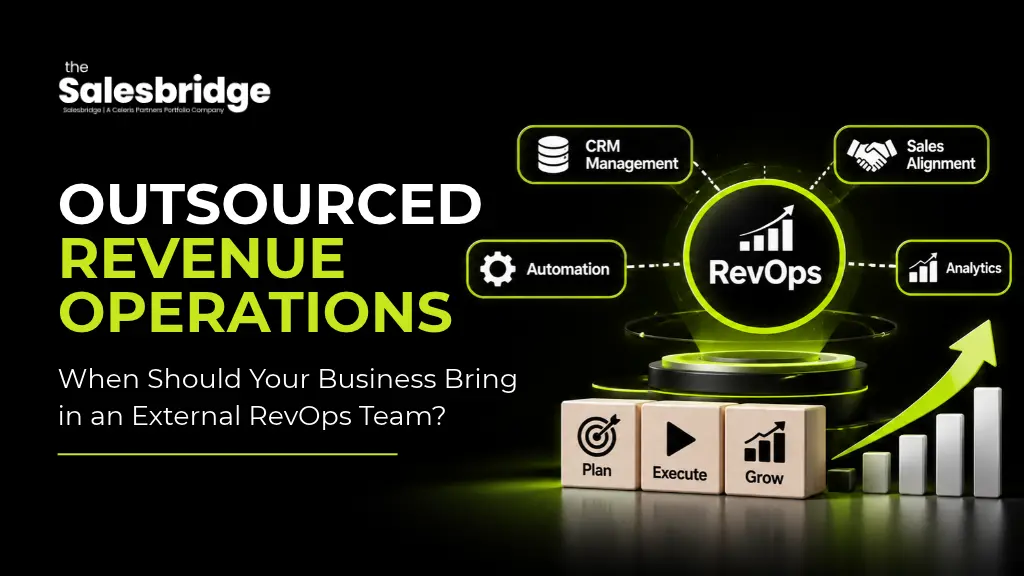
Outsourced revenue operations is a service model in which an external specialist or team supports the operational activities that connect marketing, sales and revenue management.
Rather than hiring dedicated employees for every operational requirement, a business works with an external team to improve areas such as CRM management, lead routing, sales automation, workflow optimisation, reporting and pipeline visibility.
The objective is to create consistent processes across revenue-generating departments. Marketing should understand how leads are evaluated, sales should know who owns each opportunity, and management should have reliable information for decision-making.
For example, a growing SaaS company may generate enquiries through SEO, paid campaigns and outbound prospecting. However, its CRM may contain duplicate records, inconsistent lead stages and incomplete reporting. An external RevOps team can help standardise the system, improve workflows and make the lead journey easier to manage.
A CRM should help teams organise prospects, manage opportunities and understand customer interactions. However, as businesses expand, records can become inconsistent and workflows increasingly difficult to maintain.
Common problems include duplicate contacts, outdated information, incorrect ownership, inconsistent lifecycle stages and reports that do not match actual sales activity.
If employees spend more time correcting CRM records than using the system to support their work, external CRM and RevOps expertise may be worth considering.
An outsourced team can help review the existing setup, improve data organisation and establish processes that support consistent usage.
Revenue performance suffers when marketing and sales teams use different definitions, reporting methods or qualification standards.
Marketing may consider a contact qualified after a campaign interaction, while sales expects evidence of a business requirement and suitable company fit. Without agreed criteria, leads can be rejected, ignored or followed up inconsistently.
An external RevOps team can help establish shared lifecycle stages, qualification definitions, ownership rules and reporting processes.
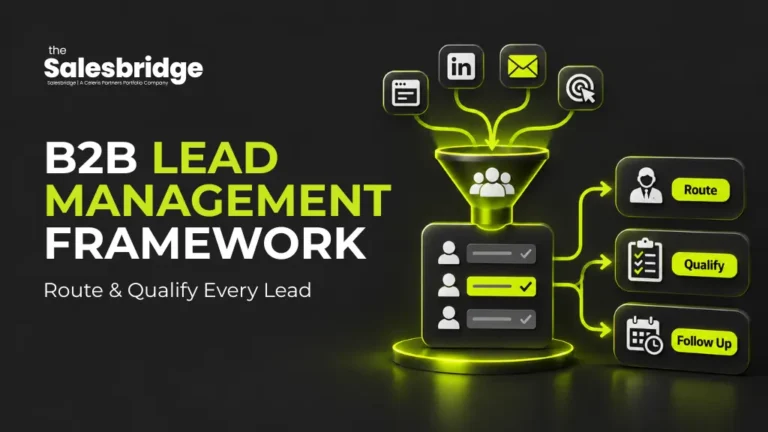
A structured B2B revenue operations framework helps connect lead capture, qualification, sales handoffs and pipeline measurement.
A qualified prospect can lose interest when nobody takes responsibility for the next action.
This often happens when routing rules are outdated, territories are unclear or CRM automation does not reflect the current sales structure.
Companies targeting multiple industries or regions may also struggle to assign enquiries correctly.
Outsourced revenue operations can help businesses review assignment rules, improve routing workflows and establish processes for handling unassigned or duplicate leads.
Smaller and growing B2B companies may have experienced marketing and sales professionals but no dedicated person responsible for the systems and processes connecting their activities.
As a result, CRM improvements, reporting requirements and workflow projects become additional responsibilities for existing employees.
An external RevOps partner provides access to specialist operational support without requiring an immediate full-time hire. This can be useful when the business needs expertise for a defined project or ongoing support at a level that does not justify a complete internal department.
Leadership needs more than a report showing how many leads or meetings were generated.
Businesses should understand how prospects move through the pipeline, which stages create delays, how opportunities progress and where revenue may be getting lost.
If marketing, sales and management rely on separate spreadsheets or inconsistent CRM reports, performance discussions become difficult.
A RevOps team can help standardise reporting, improve data accuracy and create dashboards that connect operational activity with pipeline performance.
Expansion into the USA, UK or additional industry segments introduces new operational requirements.
Companies may need different territory rules, account ownership structures, qualification criteria and reporting views. Existing CRM workflows may no longer support the complexity of the growing sales organisation.
External RevOps support can help adapt systems and processes before operational gaps become difficult to manage.
The scope of outsourced RevOps depends on the company’s needs, but several operational areas are particularly relevant to growing B2B businesses.
This includes reviewing CRM structure, maintaining records, improving data quality and establishing consistent processes for managing contacts, companies and opportunities.
The goal is to make CRM information useful and dependable for the teams working with it.
An external team can help define how leads enter the system, how qualification stages work and which representatives receive specific enquiries.
Clear routing rules reduce manual assignment and help ensure that prospects reach the appropriate team.
For further guidance, see the B2B lead management framework.
Repeated manual activities can slow down sales and marketing operations. Workflow automation can support lead assignment, task creation, notifications, follow-up processes and routine CRM updates.
However, automation should follow clearly defined business rules. Automating an unclear process can create more problems rather than improve efficiency.
Reporting connects operational activity with business performance.
Relevant metrics may include lead acceptance, response time, pipeline conversion, opportunity value, sales cycle length and campaign contribution.
A consistent reporting structure helps leadership identify where processes need attention and which activities are supporting revenue objectives.
The right model depends on how much operational support your company needs and whether the requirement is temporary, ongoing or strategic.
In-house RevOps is generally suitable for organisations that require continuous internal ownership, daily coordination and close involvement in commercial decisions. A dedicated employee or department can develop deep knowledge of the company’s systems and processes.
Outsourced RevOps is useful when a business needs specialist expertise, additional execution capacity or support without committing to a full internal team. It can also help with specific projects such as CRM restructuring, workflow improvements and reporting development.
Fractional RevOps provides senior operational support on a part-time or agreed-capacity basis. It may suit companies that need experienced guidance but do not require a full-time leader.
These models are not mutually exclusive. Some businesses retain an internal owner while outsourcing specialist implementation or ongoing technical work.
The important distinction is ownership. Your organisation should retain control of business strategy, data access and important revenue decisions, even when execution is supported externally.
The cost of revenue operations outsourcing depends on the engagement model, project complexity, technology requirements and level of support.
A defined CRM improvement project will have different requirements from an ongoing engagement involving workflow management, reporting and operational support.
Common commercial models include project-based pricing, monthly retainers and fractional support arrangements.
Before comparing proposals, clarify what is included. Ask whether the engagement covers strategy, implementation, maintenance, documentation, reporting and internal team training. Also establish how additional requests will be handled.
Rather than choosing the lowest-cost provider, evaluate whether the proposed scope addresses your operational problems and creates measurable improvements.
Start by identifying the operational problems you want to solve. A provider should understand your existing CRM, sales process, marketing workflows and reporting requirements before recommending changes.
Evaluate its experience with CRM management, lead routing, sales automation, analytics and process optimisation. Ask how it documents workflows, communicates progress and measures completed work.
It is also important to establish data access, confidentiality, system permissions and ownership of configurations. Your business should not become dependent on an external provider for information or processes that it cannot independently understand.
Finally, agree on measurable deliverables. These could include improved lead assignment, standardised lifecycle stages, cleaner CRM records, more reliable dashboards or documented workflow rules.
An outsourced RevOps team supports the systems and processes connecting marketing, sales and revenue management. Its responsibilities may include CRM management, lead routing, workflow automation, data organisation, reporting and pipeline process improvement.
A company should consider outsourcing when CRM complexity increases, internal expertise is limited, reporting becomes unreliable, lead handoffs break down or important operational projects cannot be completed by the existing team. It is particularly useful when specialist support is needed without hiring a full-time RevOps department.
Neither model is universally better. Outsourcing can provide flexible access to specialist skills and additional capacity, while an in-house team offers continuous internal ownership. The right choice depends on operational complexity, budget, workload and the level of daily support required.
Services can include CRM management, lead routing, sales automation, workflow optimisation, reporting, analytics and process improvement. The exact scope depends on the provider and the requirements agreed upon by the business.
Measure improvements against the operational problems identified at the beginning. Useful indicators include CRM data accuracy, lead response time, routing efficiency, sales acceptance rate, pipeline visibility, reporting reliability and workflow completion. Connect these improvements with opportunity conversion and revenue performance where the data supports it.
Revenue growth depends on more than generating leads. Businesses also need organised systems, reliable data, consistent follow-up and clear processes that help marketing and sales work towards shared objectives.
The Salesbridge supports B2B companies through Revenue Operations services, including CRM management, sales automation, lead routing, analytics and workflow optimisation.
Whether your business needs to improve existing CRM processes, organise lead management or create better visibility across its sales pipeline, The Salesbridge can help align operational activities with your growth requirements.
Connect with The Salesbridge to discuss a revenue operations approach built around stronger processes, improved visibility and scalable B2B growth.