Building a consistent sales pipeline requires more than having a strong product and an experienced closing team. B2B companies also need people who can identify target accounts, reach decision-makers, start relevant conversations and qualify potential opportunities before passing them to sales.
For many businesses in the United States and United Kingdom, building an internal Sales Development Representative (SDR) team can involve significant recruitment, training, management and technology costs. It can also take time to establish a repeatable prospecting process.
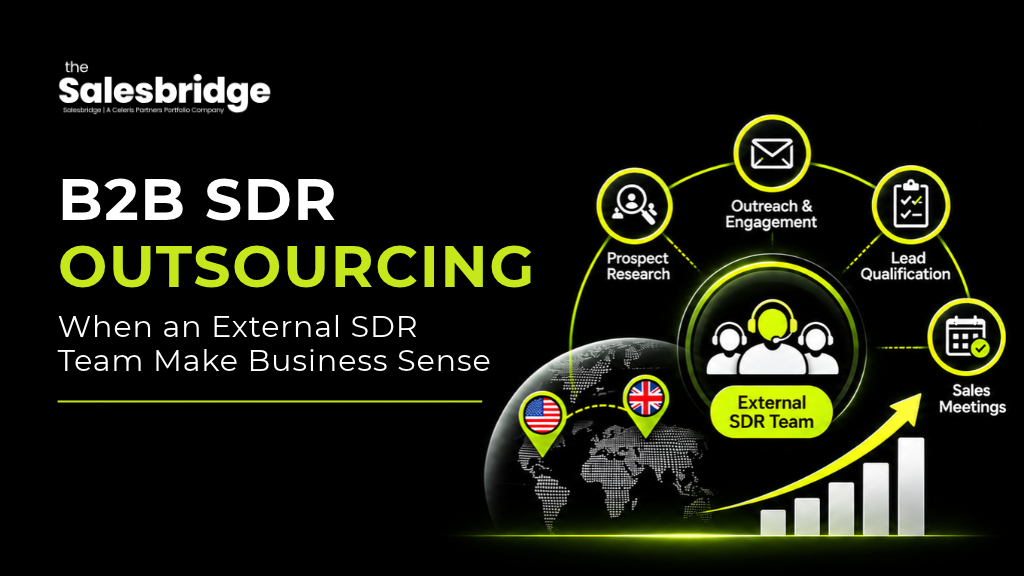
B2B SDR outsourcing offers another option. Companies can work with an external sales development team to manage prospect research, outbound outreach, lead qualification, follow-ups and appointment setting without recruiting every SDR internally.
However, outsourcing is not automatically the right choice. It makes commercial sense when a company needs additional prospecting capacity, wants to enter a new market, or requires a structured outbound function without taking on the full responsibility of building one.
Understanding when to outsource, what an external SDR team should handle and how to measure its performance helps businesses make a more informed decision.
B2B SDR outsourcing is the practice of assigning sales development activities to an external team or specialist provider instead of managing the entire function internally.
An outsourced SDR team works with the client’s sales and marketing teams to identify potential buyers, initiate conversations, assess prospect fit and arrange qualified meetings for account executives.
The provider may supply trained SDRs, prospect research resources, outreach processes, campaign management and reporting. The client generally provides product knowledge, target customer requirements, positioning, qualification standards and sales direction.
Typical outsourced SDR responsibilities include:
The objective is to create meaningful sales conversations, not simply increase the number of contacts in a database.
The decision to outsource should be based on an identifiable business requirement. The following situations are common reasons to consider an external SDR team.
Account executives are expected to conduct discovery calls, prepare proposals, manage opportunities and close deals. When they also spend a large part of their day researching accounts and initiating cold outreach, selling time can become limited.
An outsourced SDR team can take responsibility for defined prospecting activities, allowing internal salespeople to concentrate on qualified conversations and deal progression.
This arrangement is particularly useful when the business has a clear target audience but lacks the resources to maintain consistent outbound activity.
Expanding into another geographic market requires more than translating existing sales messages.
Companies need to identify local target accounts, understand relevant job roles, adapt communication and determine which industries offer the strongest opportunities.
An external SDR partner can support market research and prospecting for US or UK audiences while the internal team manages commercial strategy and sales conversations.
Before launching, establish the target geography, industry segments, decision-maker profiles and communication requirements for each market.
An in-house SDR involves more than base salary. The total cost can include recruitment, onboarding, training, management time, employee benefits, CRM access, prospecting tools and data subscriptions.
An outsourced SDR arrangement replaces some of these responsibilities with an agreed service fee. The provider may manage recruitment, training, day-to-day supervision and resource continuity, depending on the contract.
Businesses should compare the complete cost of both models rather than assuming that an external provider is always cheaper.
A company considering a new industry, product segment or geographic market may not have enough evidence to justify permanent SDR recruitment.
A scoped outsourcing engagement can help test account selection, messaging, buyer response and qualification requirements before the business commits to expanding its internal team.
The findings can also help establish a more informed outbound strategy.
Outsourcing does not require a company to replace its internal sales development team.
An external team can support a specific campaign, industry segment, account list or geography while internal SDRs continue managing strategic accounts and complex opportunities.
This hybrid model can increase prospecting coverage without changing the entire sales organisation.
Both approaches can generate sales opportunities, but they distribute responsibility differently.
| Factor | In-house SDR team | Outsourced SDR team |
|---|---|---|
| Recruitment | Managed by the company | Usually managed by the provider |
| Training | Internal responsibility | Provider-led with client product training |
| Operating costs | Payroll, benefits, tools and management | Agreed service fee and any additional costs |
| Daily supervision | Internal sales management | Provider management with client oversight |
| Product knowledge | Builds through direct internal exposure | Depends on onboarding and ongoing feedback |
| Scalability | Requires hiring and internal capacity | Can be adjusted within the service agreement |
| Process ownership | Direct internal control | Shared responsibilities defined by contract |
| Best suited for | Long-term internal sales development | Additional capacity, market testing and managed execution |
An in-house team may be more suitable when a company has a mature outbound process, experienced SDR management and a strong need for deep product knowledge.
An external team may be a better fit when the business needs execution capacity, wants to test a market or cannot justify the recruitment and management requirements of an internal function.
The decision should consider control, cost, speed, product complexity and the company’s ability to manage sales development.
The service scope should be agreed before the engagement begins. A reliable outsourced SDR programme connects prospecting activities with clear qualification and sales handoff procedures.
The team should understand the client’s ideal customer profile (ICP), including industry, company size, location, business model and relevant buying roles.
Research should identify companies with a reasonable fit and the people involved in purchasing decisions. For example, a B2B cybersecurity provider may target CISOs, IT Directors and security leaders rather than building a broad list of unrelated business contacts.
An external SDR team may use email, telephone and LinkedIn to reach selected prospects.
Messaging should reflect the target audience’s business challenges and explain why the conversation may be relevant. Outreach should follow approved messaging, contact preferences and applicable market requirements.
Interested prospects should be assessed against agreed qualification criteria before being passed to the sales team.
These criteria may include company fit, decision-making responsibility, business need, interest and the next expected step.
The B2B lead qualification framework can help businesses establish consistent standards for deciding when a prospect is ready for sales engagement.
The cost of B2B SDR outsourcing depends on the number of resources, campaign scope, target market, outreach channels, data requirements and level of management included.
Common pricing arrangements include:
Monthly retainer: The client pays an agreed recurring fee for a defined service scope or team capacity. This is useful for ongoing prospecting programmes.
Dedicated SDR model: A representative or assigned team works primarily on the client’s account. The agreement should clarify working hours, supervision, tools and responsibilities.
Pay-per-qualified-meeting: Payment is linked to meetings that satisfy agreed qualification requirements. The definition of a billable meeting should specify attendee relevance, company fit and attendance conditions.
Hybrid model: A fixed service fee is combined with performance-based charges linked to agreed outcomes.
When comparing proposals, consider setup fees, technology, data, management, reporting and internal coordination costs. A low monthly fee may not represent good value if the service excludes essential activities or produces meetings that sales cannot progress.
Measuring activity alone can create a misleading picture of performance. A high number of calls, emails or booked meetings does not necessarily mean that the programme is creating qualified pipeline.
Use a combination of operational and commercial measures.
| KPI | What it tells you |
|---|---|
| Contact accuracy | Whether prospect information is reliable |
| Positive response rate | Whether outreach generates relevant interest |
| Qualification rate | How many prospects meet agreed criteria |
| Sales acceptance rate | How many leads the internal team accepts |
| Qualified meetings held | How many relevant meetings actually take place |
| Meeting-to-opportunity rate | Whether meetings progress into opportunities |
| Cost per qualified meeting | The cost of generating an accepted meeting |
| Pipeline contribution | The opportunities associated with SDR activity |
Review these measures with the sales team regularly. If meetings are being rejected, investigate targeting, qualification standards and messaging rather than simply increasing outreach volume.
A connected revenue operations and lead management process also helps maintain accurate CRM records, clear lead ownership and consistent follow-up.
Before selecting a provider, evaluate its ability to represent your business and operate within your sales process.
Relevant industry experience: Ask whether the provider has experience with your industry, buyer roles and target markets.
Research and data quality: Understand how target accounts are selected, contact information is verified and outdated records are handled.
SDR training and onboarding: Check how representatives learn your product, value proposition, customer challenges and qualification requirements.
Outreach approach: Review how campaigns are personalised, which channels are used and who approves messaging before launch.
CRM and reporting: Confirm how activity, lead status, meeting details and sales feedback are recorded.
Data ownership and compliance: Clarify who owns prospect data, campaign assets and communication records. Agree on responsibilities for privacy requests, opt-outs, data processing and applicable US and UK outreach requirements.
Performance accountability: Ask how qualified meetings are defined, how rejected leads are handled and how results are reviewed.
A provider should be able to explain its process clearly. Be cautious of promises based only on large lead volumes or guaranteed meetings without meaningful qualification standards.
An outsourced SDR team manages sales development activities such as prospect research, account targeting, outbound outreach, lead qualification, follow-ups and appointment setting. Its role is to create relevant sales conversations for the client’s internal sales team.
Yes. It can be useful for companies that need consistent prospecting but do not have the budget, management capacity or immediate requirement to build a full internal SDR department. The business should still have a clear offer, target audience and process for handling qualified meetings.
It can be, but not in every situation. Outsourcing may reduce recruitment, training, technology and management responsibilities. However, pricing depends on the provider’s scope and the client’s internal coordination costs. Compare total operating costs and sales outcomes before deciding.
The timeline depends on onboarding, data readiness, target audience, product complexity and outreach channels. Initial setup and campaign activity may begin before a consistent flow of qualified meetings develops. Agree on launch milestones and review performance against realistic expectations.
Yes. A hybrid model allows external SDRs to support defined prospecting segments while internal representatives manage strategic accounts, discovery and closing. Both teams should use shared qualification criteria, CRM processes and clear account ownership to avoid duplicate outreach.
Building a predictable sales pipeline requires consistent prospecting, relevant conversations and a clear process for moving qualified prospects into sales.
The Salesbridge supports B2B companies through SDR as a Service, B2B lead generation, appointment setting, account-based marketing, data building and demand generation. These services can help businesses reach decision-makers, qualify prospects and support sales development across the US, UK and other target markets.
If your company needs additional prospecting capacity or is evaluating an external SDR model, connect with The Salesbridge to discuss your target audience, sales development requirements and campaign objectives.