
A prospect fills out a form, downloads a guide or requests a consultation. Marketing records the conversion, but sales never follows up or receives the lead without enough information to start a meaningful conversation. Meanwhile, both teams continue reporting activity, even though a potential opportunity has stalled.
This is a common operational problem for B2B companies targeting customers in the USA and UK. Leads enter the system, but inconsistent qualification, unclear ownership, disconnected tools and delayed follow-up prevent them from progressing.
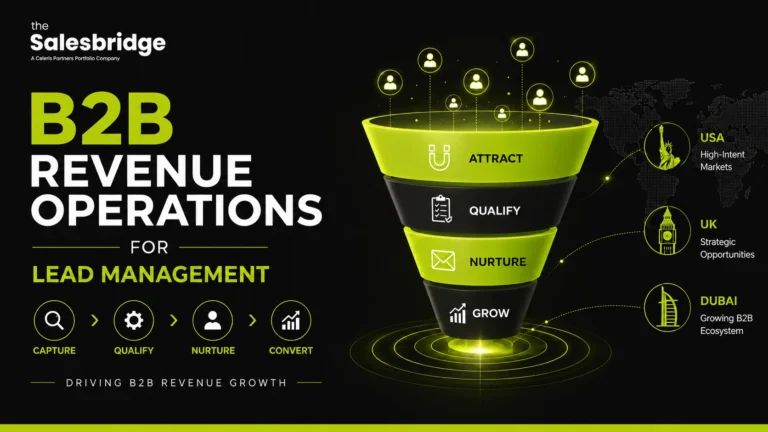
B2B revenue operations helps solve this problem by connecting marketing, sales and the processes that move prospects from initial engagement to qualified opportunities and closed revenue.
Rather than treating lead generation, CRM management and sales execution as separate activities, revenue operations establishes shared definitions, clear responsibilities, reliable data and measurable handoffs. The result is a more connected revenue process in which every qualified prospect has an owner, a next step and a measurable path forward.
B2B revenue operations, commonly called RevOps, is an operating approach that aligns marketing, sales and customer-facing teams around shared processes, technology, data and revenue objectives.
Its purpose is to make the complete buyer journey easier to manage and measure. This includes how prospects enter the CRM, how leads are qualified, how sales ownership is assigned, how opportunities progress and how performance is reported.
For example, a UK technology company may generate enquiries through organic search, LinkedIn campaigns and content syndication. Without a connected operating process, each channel may use different lead definitions, routing rules and reporting methods.
A revenue operations framework brings these activities together. It establishes consistent lifecycle stages, defines who owns each handoff and makes performance visible across the funnel.
The focus is not simply on adding more CRM software. It is on ensuring that people, processes and systems work together to support revenue growth.
A lead handoff occurs when responsibility for a prospect moves from one team or stage to another. The most familiar example is the transition from marketing to sales, but handoffs also occur between sales development representatives, account executives and customer success teams.
Problems often begin when these transitions depend on informal communication rather than documented processes.
Marketing may classify a prospect as qualified because they downloaded content or attended a webinar. Sales may expect evidence of a business need, suitable company fit or an active buying process.
When qualification criteria differ, sales receives leads it considers premature, while marketing believes its work is being ignored.
A shared qualification framework helps both teams agree on which leads require immediate sales attention and which need further nurturing.
A qualified prospect may wait hours or days because an assignment rule is outdated, a required field is missing or nobody owns the next action.
Routing problems also occur when multiple representatives contact the same account or when a lead is assigned to someone who does not cover its region or industry.
B2B revenue operations addresses these issues by defining ownership rules, validating required data and establishing escalation procedures for unassigned or untouched leads.
A contact record containing only a name and email address provides limited context for sales.
Representatives may not know which campaign generated the enquiry, what the prospect downloaded, which service they are interested in or what business challenge they are trying to solve.
Without this information, sales must repeat questions, and conversations become less relevant. Standardised CRM fields and a consistent handoff process help preserve the context that marketing has already collected.
Fixing broken handoffs requires more than improving one workflow. The complete lead journey must be defined, measured and supported by clear ownership.
Every team should understand what happens when a new contact enters the system.
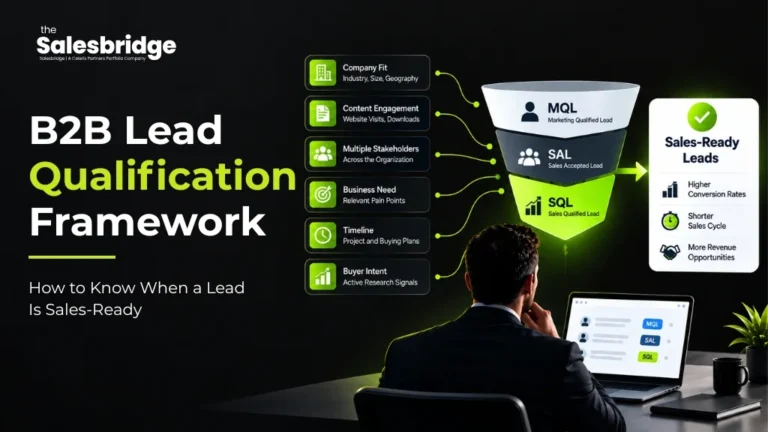
A practical lifecycle might include lead captured, marketing-qualified lead (MQL), sales-accepted lead (SAL), sales-qualified lead (SQL), opportunity created and closed won or lost.
Each stage needs a clear entry criterion and an identifiable owner. For instance, a lead should not become sales-qualified merely because a scoring threshold was reached if the agreed process also requires confirmation of a relevant business need.
Consistent definitions make conversion rates easier to interpret and help teams identify where prospects are dropping out of the journey.
Lead routing should reflect how the business sells.
A company serving multiple industries or geographic markets may assign leads according to territory, account ownership, company size, product interest or industry specialisation.
The routing process should also account for existing customers, duplicate records and contacts associated with open opportunities.
Automation can assign eligible leads, create follow-up tasks and flag records that lack the information required for routing. However, the rules must be reviewed regularly to reflect changes in territories, team structures and account ownership.
Marketing and sales should agree on what constitutes a qualified lead, how quickly sales must respond and how outcomes will be recorded.
This agreement is often documented as a service-level agreement (SLA). It defines the responsibilities of both teams rather than placing all accountability on sales.
Marketing commits to agreed qualification and data standards. Sales commits to reviewing assigned leads, following up within the agreed timeframe and recording whether the lead was accepted, rejected or moved into a later nurture stage.
A documented SLA turns expectations into a process that can be monitored and improved.
A successful handoff should give the receiving representative enough information to take the next step without restarting the entire conversation.
That information may include the prospect’s company, role, lead source, campaign engagement, stated business need, qualification status and previous interactions.
The handoff should also explain why the prospect was assigned and what action is recommended.
For companies looking to formalise this process, a structured B2B lead qualification framework can help connect qualification criteria with sales acceptance and follow-up.
A connected revenue process needs metrics that reveal both operational efficiency and commercial performance. Measuring lead volume alone cannot show whether the handoff process is working.
Measure the time between lead qualification, assignment and the first meaningful sales activity. Track the percentage of leads contacted within the agreed SLA.
These measures can reveal routing delays, workload imbalances and follow-up gaps before they become larger pipeline problems.
Track the percentage of MQLs accepted by sales, the proportion progressing to SQL and the number that become opportunities.
Review rejection reasons alongside conversion rates. If sales repeatedly rejects leads because of poor company fit or missing information, marketing and RevOps can investigate whether targeting, qualification or data enrichment needs improvement.
Monitor qualified opportunities, pipeline value, stage conversion, sales cycle length and closed-won revenue.
Where attribution data is reliable, connect these outcomes with lead sources and campaigns. Distinguish between pipeline sourced by marketing and pipeline influenced by marketing, because the two measures describe different contributions.
A consistent revenue operations and lead management process helps teams understand where prospects progress, where they stall and which operational changes deserve attention.
Companies do not need to redesign their entire technology stack before improving handoffs. Start with the most visible operational problems and expand the framework as the process matures.
First, map the existing journey from initial enquiry to opportunity creation. Identify every point where ownership changes, information is transferred or a decision is made. Look for unassigned leads, repeated data entry, unclear stage definitions and missing follow-up records.
Next, agree on the qualification criteria and ownership rules. Document which team owns each stage, which fields are mandatory and what action should happen when a lead is accepted, rejected or left untouched.
Then review the CRM and marketing automation workflows. Correct outdated assignment rules, improve data validation, identify duplicate records and automate routine tasks where appropriate. Avoid automating a process before the underlying rules are clear.
Finally, establish a regular review involving marketing, sales and operations. Examine lead acceptance, response times, rejection reasons and opportunity conversion. Use the findings to refine qualification, targeting, routing and follow-up.
This approach makes B2B revenue operations an ongoing improvement process rather than a one-time CRM project.
Revenue operations becomes particularly valuable when marketing generates leads but sales cannot consistently convert them into opportunities, when multiple teams use conflicting metrics or when leadership lacks a reliable view of pipeline performance.
It can also help growing companies expanding across the USA and UK, where separate territories, account ownership rules and sales processes can introduce additional complexity.
The right starting point depends on the business. Some companies need better lead routing and CRM hygiene. Others need consistent qualification standards, improved reporting or clearer accountability between marketing and sales.
The priority should be the operational bottleneck with the greatest effect on the buyer journey—not the number of tools the business can implement.
B2B revenue operations is an operating framework that aligns marketing, sales and other revenue-related functions through shared processes, data, technology and performance measures. It helps businesses manage the buyer journey more consistently, from lead capture through opportunity creation and customer growth.
Revenue operations establishes common qualification criteria, clear ownership, documented service-level agreements, reliable CRM data and measurable follow-up processes. These controls help ensure qualified leads reach the correct representative with the context needed for timely action.
Sales operations primarily supports the sales function through processes, tools, reporting and performance management. RevOps takes a broader view, coordinating operational processes across marketing, sales and other revenue-related teams throughout the customer lifecycle.
Useful KPIs include lead response time, SLA compliance, MQL-to-SAL acceptance, SAL-to-SQL conversion, opportunity creation, sales cycle length, pipeline value and closed-won revenue. The most relevant measures depend on the company’s sales model and should use consistent definitions.
A small B2B company may not need a dedicated RevOps department, but it can still benefit from revenue operations principles. Clear lead ownership, consistent CRM data, agreed qualification criteria and regular marketing-sales reviews can improve operational efficiency without requiring a large team.
Generating leads is only one part of building a sustainable B2B pipeline. Companies also need clear qualification processes, reliable follow-up and alignment between marketing activity and sales outcomes.
The Salesbridge helps B2B companies explore B2B lead generation, demand generation, content syndication, account-based marketing and appointment setting to reach relevant decision-makers and support pipeline development.
If your marketing leads are not progressing consistently, start by identifying where the handoff breaks and what information or ownership is missing.
Explore The Salesbridge to discuss how a more connected demand generation and lead management approach can support your growth objectives in the USA and UK.